How to Tell If a Handbag Zipper Is Good Quality
A handbag zipper is one of the first details that reveals how carefully a bag was made. It may look small compared with the leather, shape, color, or hardware, but it is one of the most used parts of any handbag. Every time you reach for your phone, wallet, keys, lipstick, cardholder, passport, or sunglasses, the zipper has to work smoothly.
A good handbag zipper should feel controlled, secure, and easy to use. It should not fight your hand, scrape your skin, catch the lining, or open by itself while you walk. For women who use a handbag every day in the USA—for work, errands, commuting, travel, school pickup, shopping, or weekend plans—zipper quality directly affects comfort, security, and long-term value.
Why Zipper Quality Matters in a Handbag
A zipper is not only a closure. It is a mechanical part attached to the bag’s body, lining, stitching, and interior structure. If the zipper is weak, the whole bag can become frustrating to use even when the exterior looks beautiful.
Poor-quality zippers often create everyday problems: they stick, separate, scrape, catch the lining, or slowly open while the bag is being carried. A weak zipper can also damage other parts of the bag. When a slider jams and the user pulls harder, the lining can tear, the stitch line can loosen, or the zipper tape can distort.
Replacing a handbag zipper is also not a simple surface repair. A cobbler or leather repair specialist often has to open seams, remove part of the lining, replace the zipper track, and re-stitch the area. That is why zipper quality should be checked before buying, not after the problem starts.
| What the zipper affects | Why it matters |
|---|---|
| Daily usability | A smooth zipper makes the bag easier to open and close with less effort. |
| Security | A secure zipper helps keep phone, wallet, passport, keys, and cards inside the bag. |
| Comfort | Polished teeth and a clean slider reduce scratching and snagging. |
| Durability | A strong zipper track resists separation, distortion, and early failure. |
| Construction quality | Clean zipper stitching and neat tape finishing show better workmanship. |
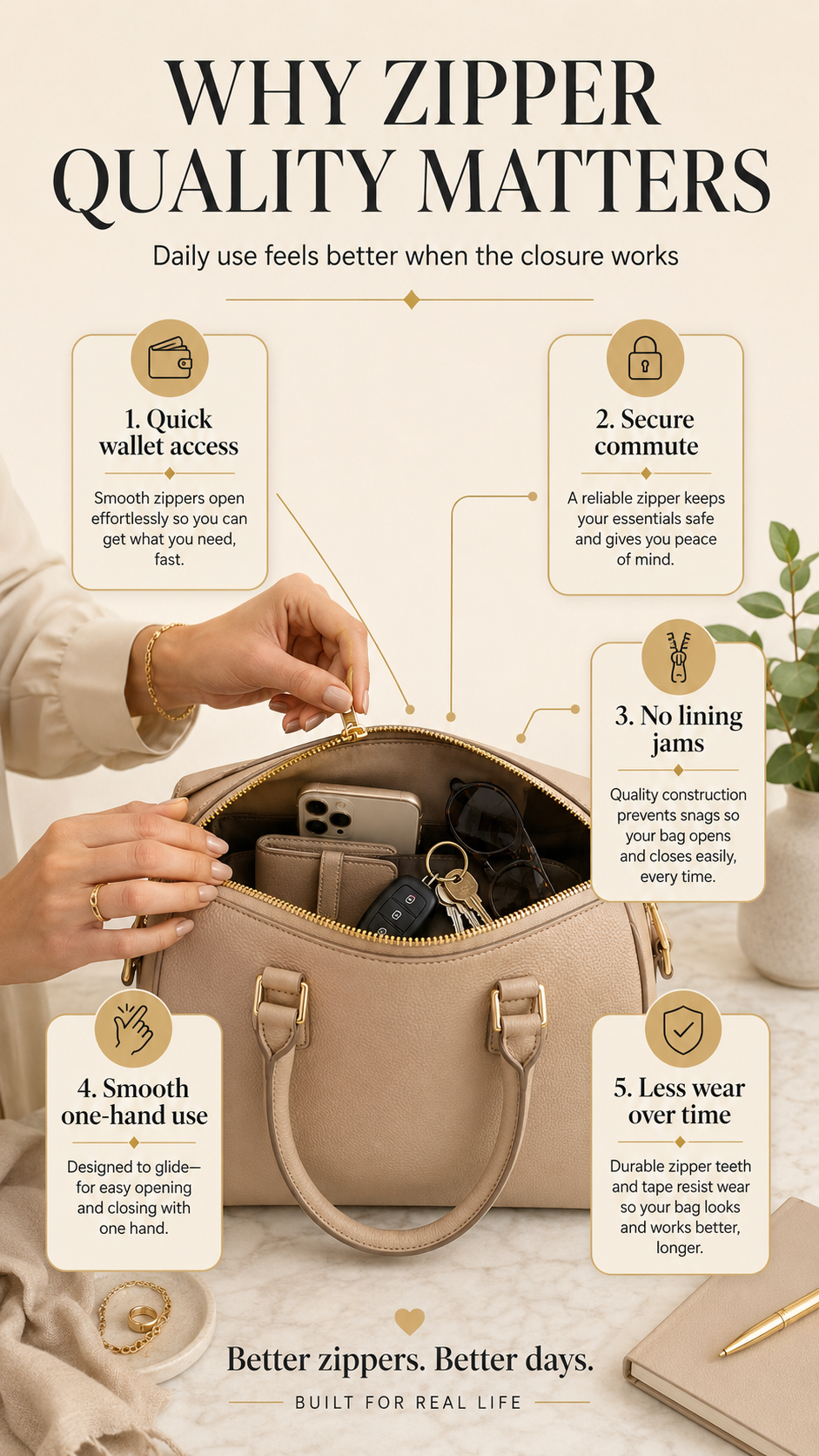
The First Test: Smooth Glide
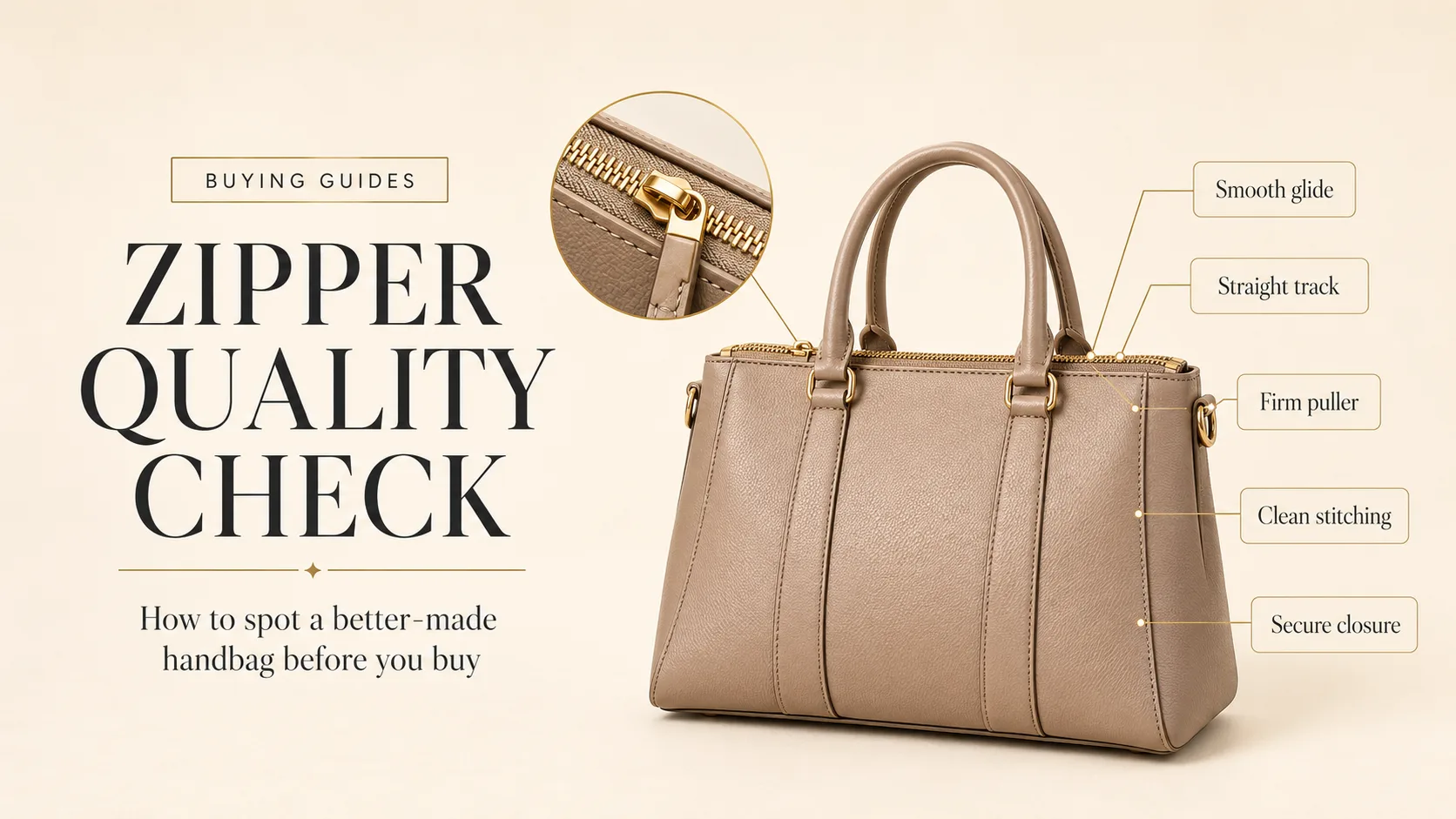
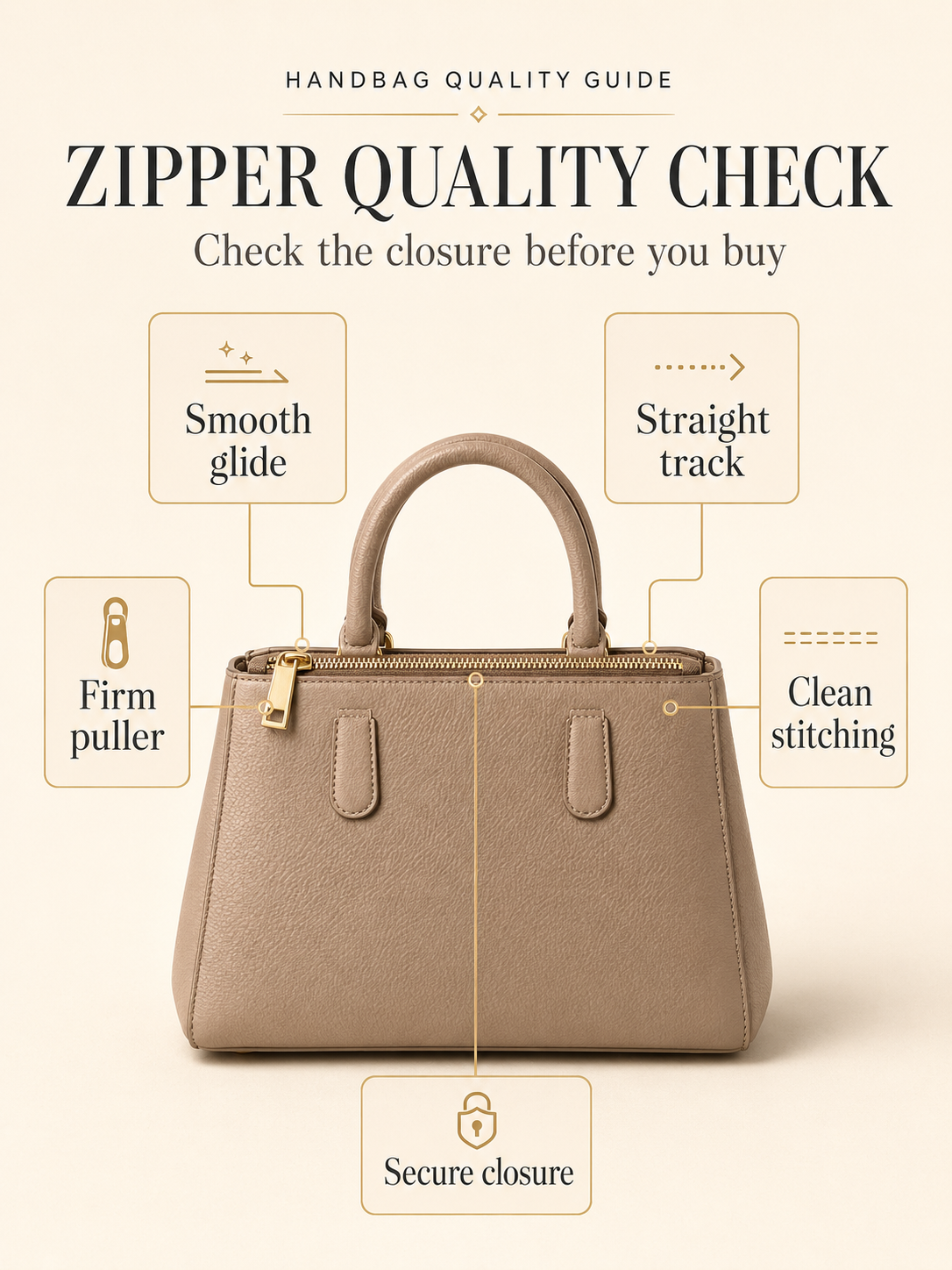
The easiest way to judge a handbag zipper is to open and close it several times. A quality zipper should glide with steady resistance from one end to the other. It does not need to feel loose, but it should feel controlled and predictable.
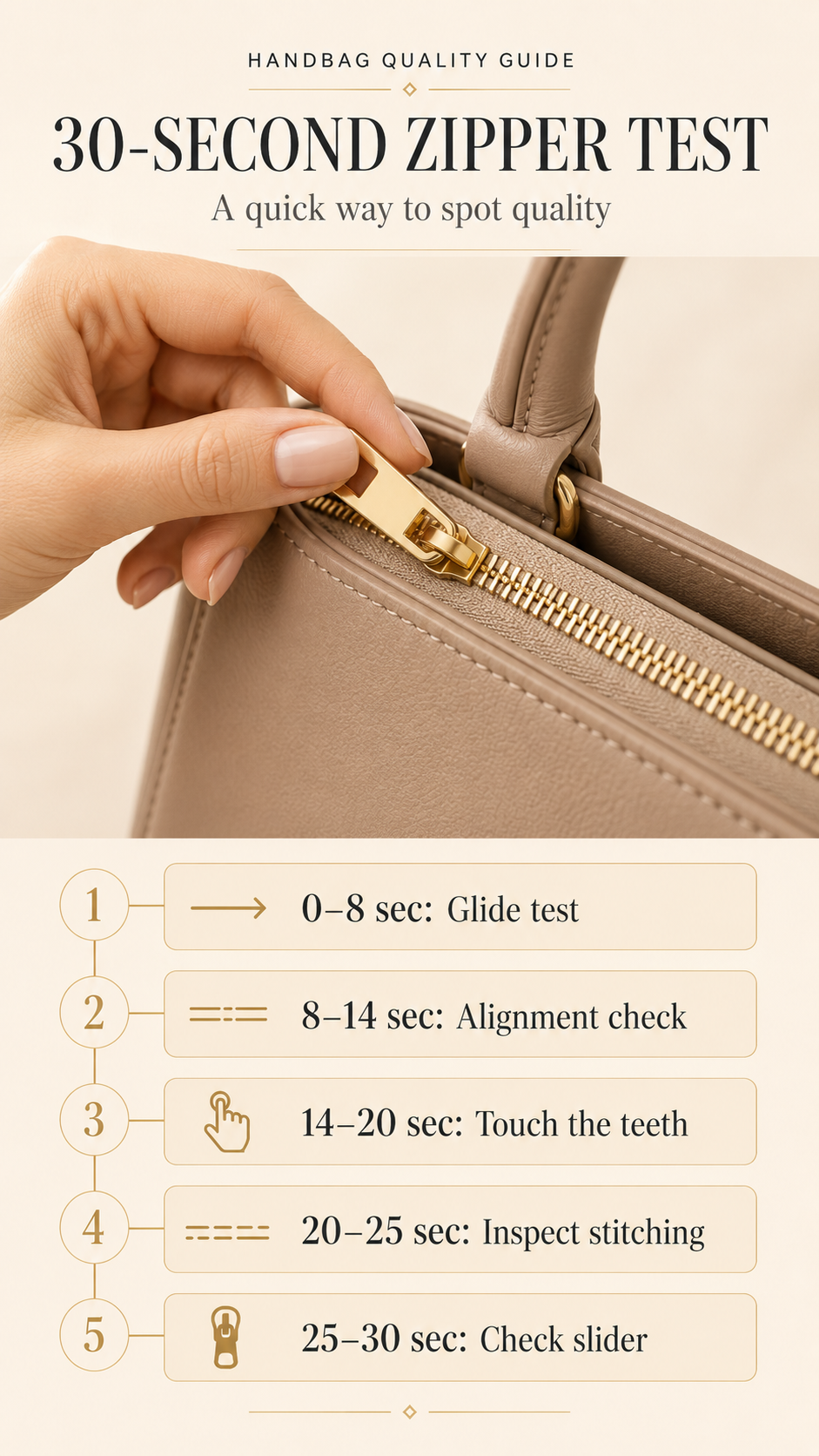
Hold the handbag steady with one hand and move the zipper pull with the other. Open the zipper fully, then close it fully. Repeat this three times. Pay attention to whether the slider catches in the same place, whether the zipper feels rough, and whether you need to pull harder than expected.
A good zipper feels smooth even when used slowly. A weak zipper often reveals itself when you move it slowly because you can feel every rough spot, tight point, or uneven section of the track.
| Good zipper feel | Poor zipper feel |
|---|---|
| Moves smoothly from end to end | Stops, catches, or jumps forward |
| Resistance feels consistent | Some areas feel tight and some feel loose |
| Can be opened with light hand pressure | Needs force or two hands |
| Does not catch the lining | Pulls fabric into the slider |
| Sounds controlled and even | Sounds harsh, scratchy, or rattly |
Check the Zipper Track Alignment
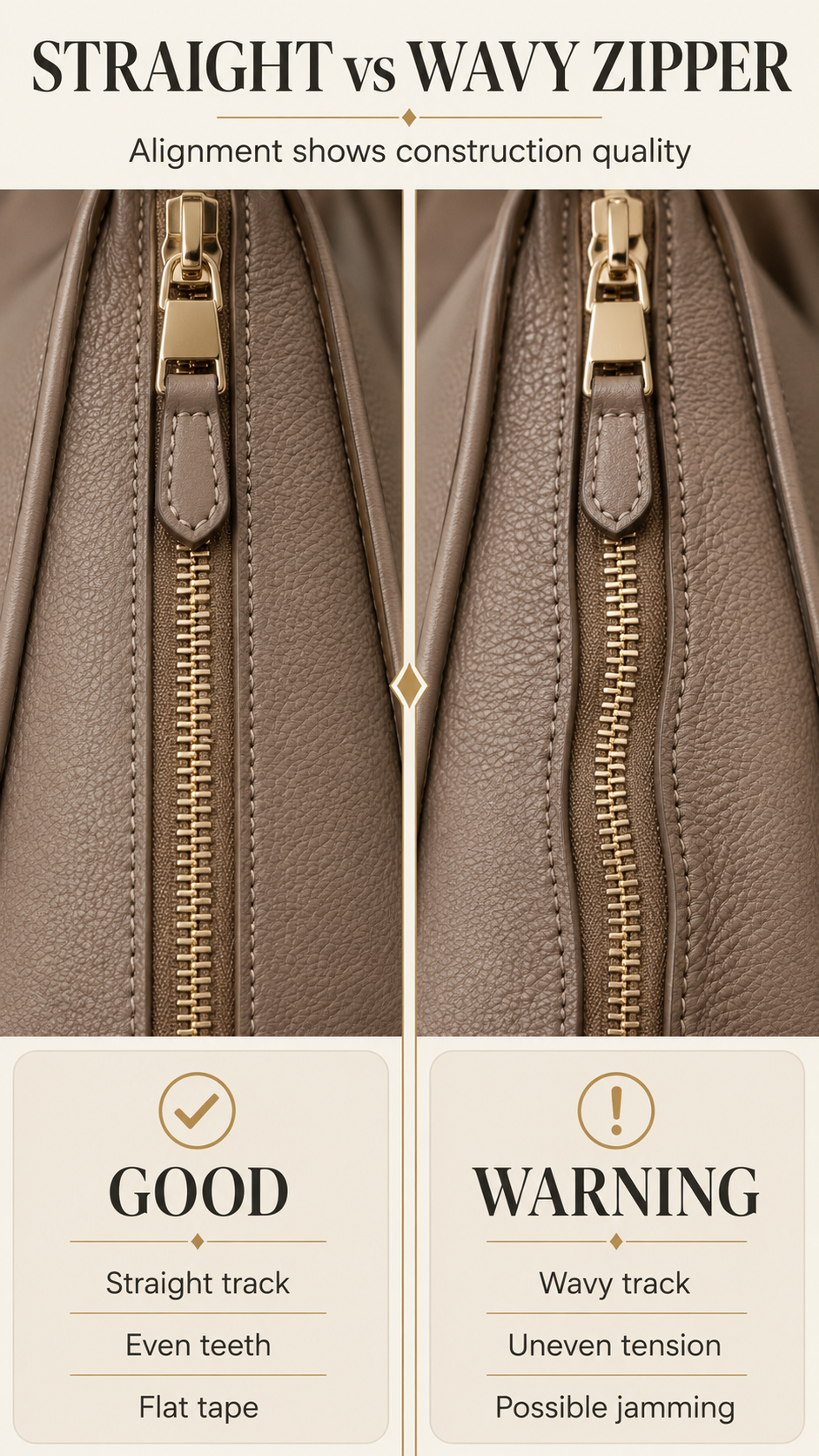
After testing the glide, close the zipper completely and look straight down at the track. A quality zipper should sit flat and straight. The teeth or coil should meet evenly without waves, gaps, twisting, or puckering.
If the zipper line looks wavy, the issue may not be the teeth alone. It can come from uneven sewing tension, weak zipper tape, poor lining support, or a zipper that was attached without enough precision. A wavy zipper track is more likely to catch, separate, or wear unevenly over time.
| Area to inspect | Quality signal | Warning sign |
|---|---|---|
| Closed zipper line | Straight, flat, and even | Wavy, raised, or twisted |
| Teeth or coil spacing | Consistent from end to end | Irregular gaps or crowded areas |
| Zipper tape | Sits flat beside the track | Puckers, ripples, or pulls unevenly |
| Slider movement | Follows the track naturally | Jams at curves or raised spots |
This check is especially important on structured satchels and work bags because those bags often carry heavier daily items. If you are comparing structured bags, zipper alignment should be checked along with shape, stitching, strap attachment, and lining quality. For a broader construction check, see our guide on how to check handbag stitching quality before you buy.
Feel the Teeth or Coil
The zipper elements should feel safe and comfortable around your hand. On metal zippers, the teeth should feel polished, not sharp. If the teeth feel jagged, rough, or scratchy, they may snag clothing, scrape your hand, or damage small leather goods inside the bag.
Run your finger gently along the open zipper teeth. Do not press aggressively; the goal is to feel the finish. Smooth metal teeth are a better sign than teeth that feel like a nail file. On coil zippers, the coil should feel even and continuous, not crushed, bent, or broken.
| Zipper type | Good quality signal | Problem signal |
|---|---|---|
| Metal zipper | Teeth feel smooth, rounded, and evenly finished | Teeth feel sharp, jagged, scratchy, or abrasive |
| Nylon or polyester coil zipper | Coil looks continuous and moves smoothly | Coil is crushed, uneven, stretched, or distorted |
| Plastic molded zipper | Elements are clean, smooth, and secure | Cracked, missing, rough, or poorly molded teeth |
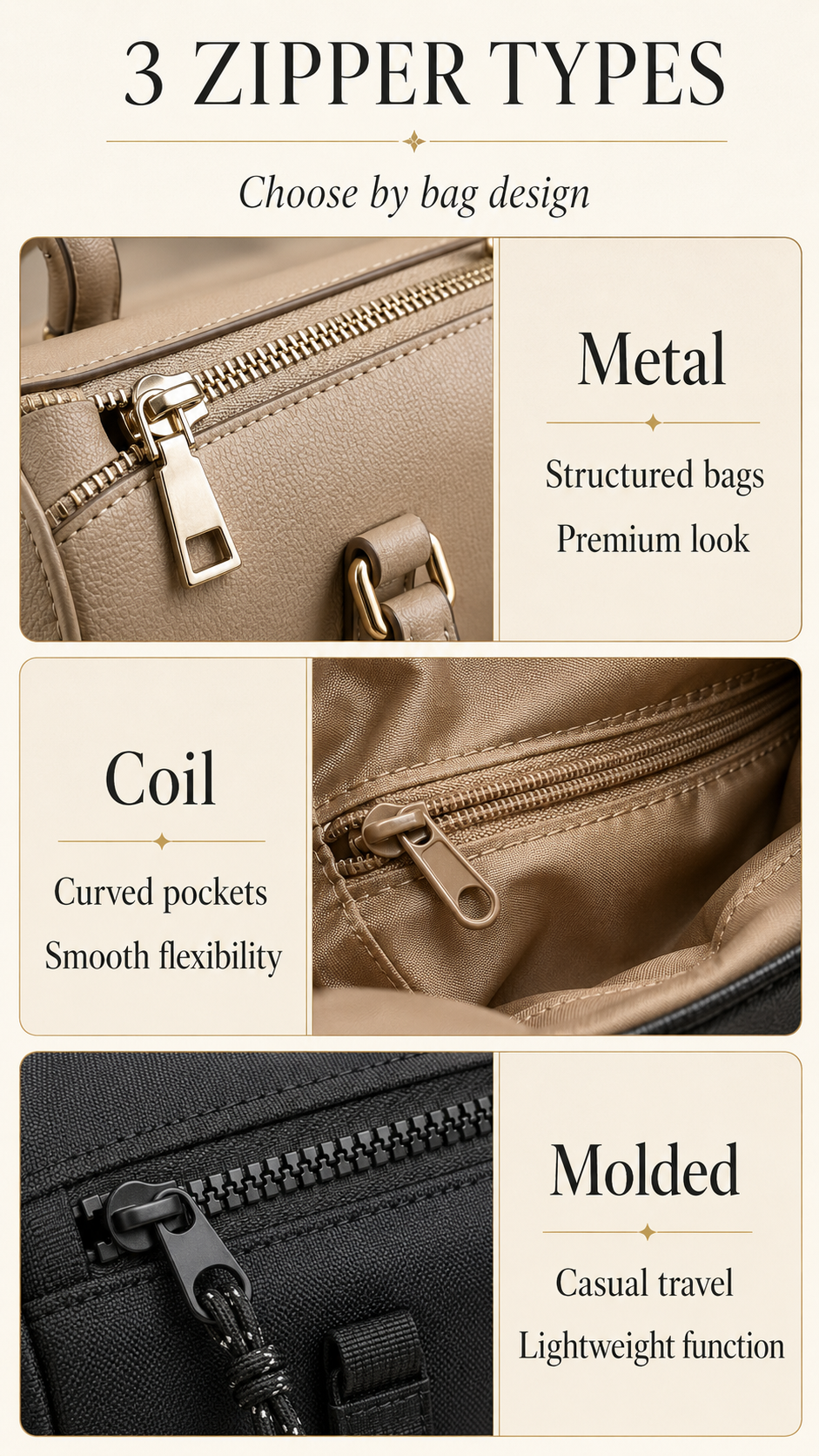
A metal zipper can look premium, but it must be polished and properly aligned. A coil zipper can look simpler, but it can be excellent for curved bags, interior pockets, travel bags, and lightweight designs. The best zipper is the one that matches the bag’s structure and use.
Metal Zipper vs Coil Zipper vs Plastic Molded Zipper
Different handbag styles use different zipper types. A structured leather satchel may look better with a polished metal zipper. A curved hobo bag or travel bag may work better with a flexible coil zipper. A sporty backpack or utility bag may use a plastic molded zipper because it is lightweight and practical.
| Zipper type | Best for | Strength | What to inspect |
|---|---|---|---|
| Metal element zipper | Structured handbags, satchels, leather bags, premium-looking closures | Strong and visually substantial when well-made | Smooth teeth, clean finish, no sharp edges, no flaking |
| Nylon or polyester coil zipper | Interior pockets, curved openings, travel bags, soft handbags | Flexible and smooth for curved paths | Even coil, no crushed section, no lining caught in slider |
| Plastic molded zipper | Casual bags, backpacks, sporty totes, utility styles | Lightweight and functional | No cracked teeth, no missing elements, secure slider movement |
Do not judge the zipper by material alone. A poorly made metal zipper can be worse than a well-made coil zipper. The real quality test is movement, alignment, comfort, stitching, tape stability, and closure security.
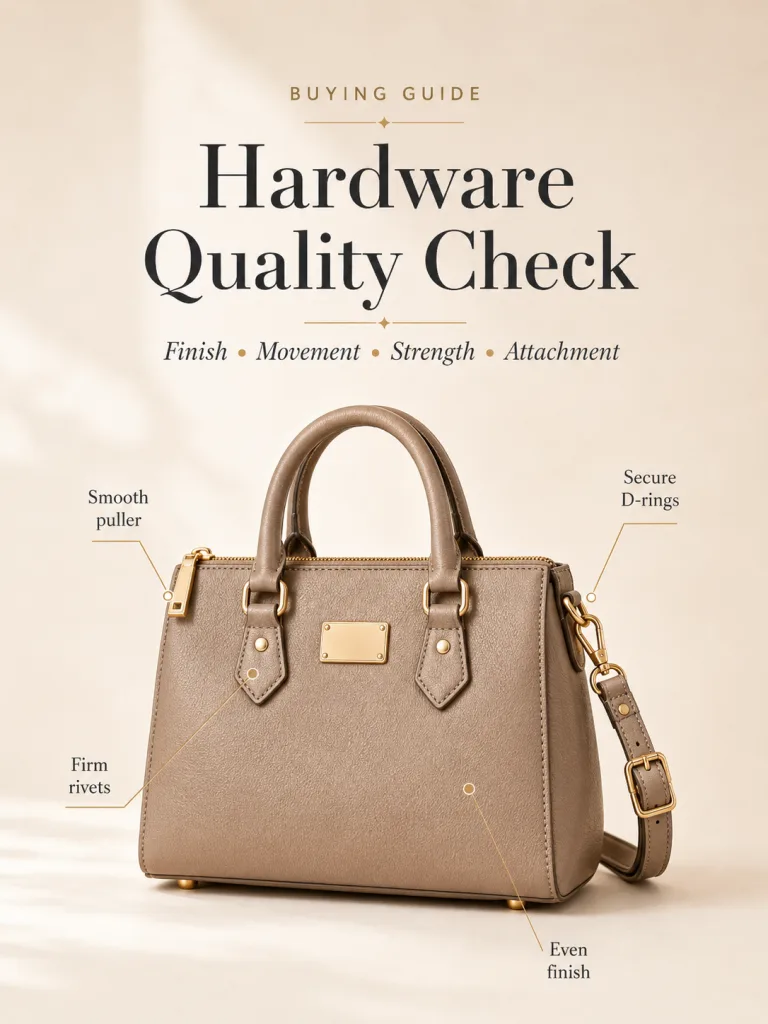
Inspect the Slider and Puller
The slider is the moving part that opens and closes the zipper. The puller is the tab you hold. These parts receive repeated hand pressure, so they should feel stable and well-finished.
A quality puller should be easy to grip, comfortable in the hand, and securely attached. It should not feel like thin metal that can bend easily. The slider should sit squarely on the track. It should not wobble, tilt, or feel loose while moving.
| Part | Good quality signal | Warning sign |
|---|---|---|
| Puller tab | Firm, comfortable, smooth edges | Thin, sharp, flimsy, or hard to grip |
| Puller attachment | Secure loop or crown connection | Loose, rattly, stretched, or weak connection |
| Slider body | Stable and properly fitted to the track | Wobbly, tilted, rough, or distorted |
| Surface finish | Even color and smooth coating | Bubbling, peeling, flaking, or patchy finish |
| Daily behavior | Stays closed during normal movement | Slowly creeps open while carrying the bag |
Some premium or branded zippers may include clear maker markings on the slider. A clean stamp can be a positive sign, but it should never be the only quality test. Always judge the actual zipper: how it moves, how it feels, how it is stitched, and whether it stays secure.
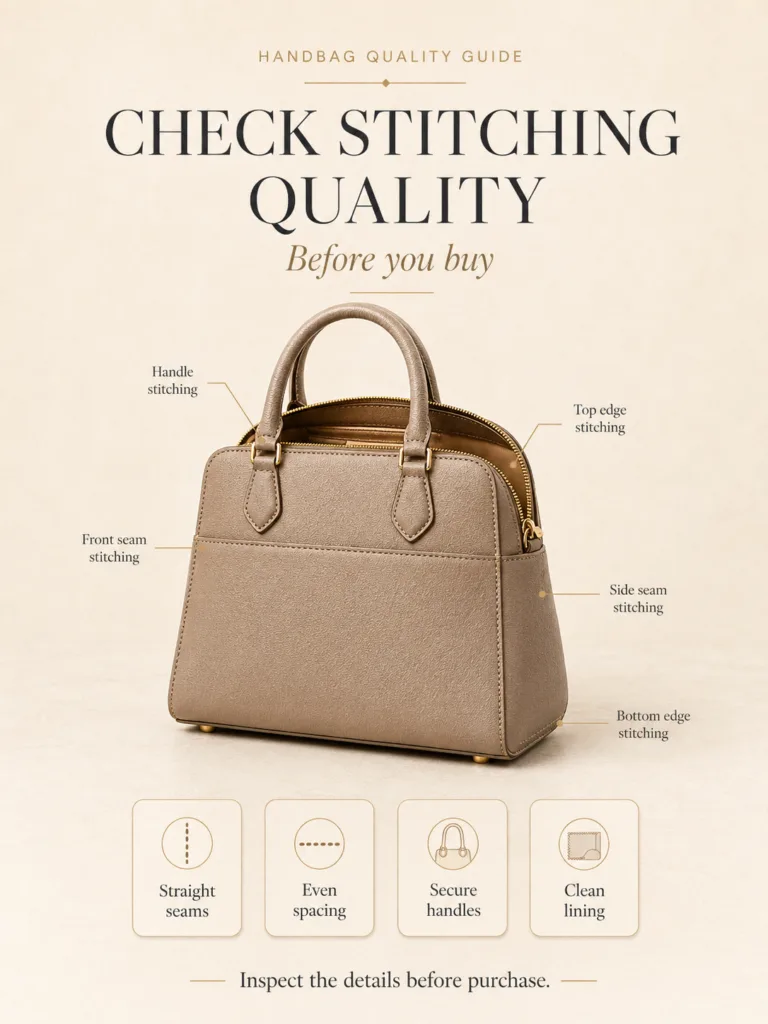
Check the Zipper Stitching
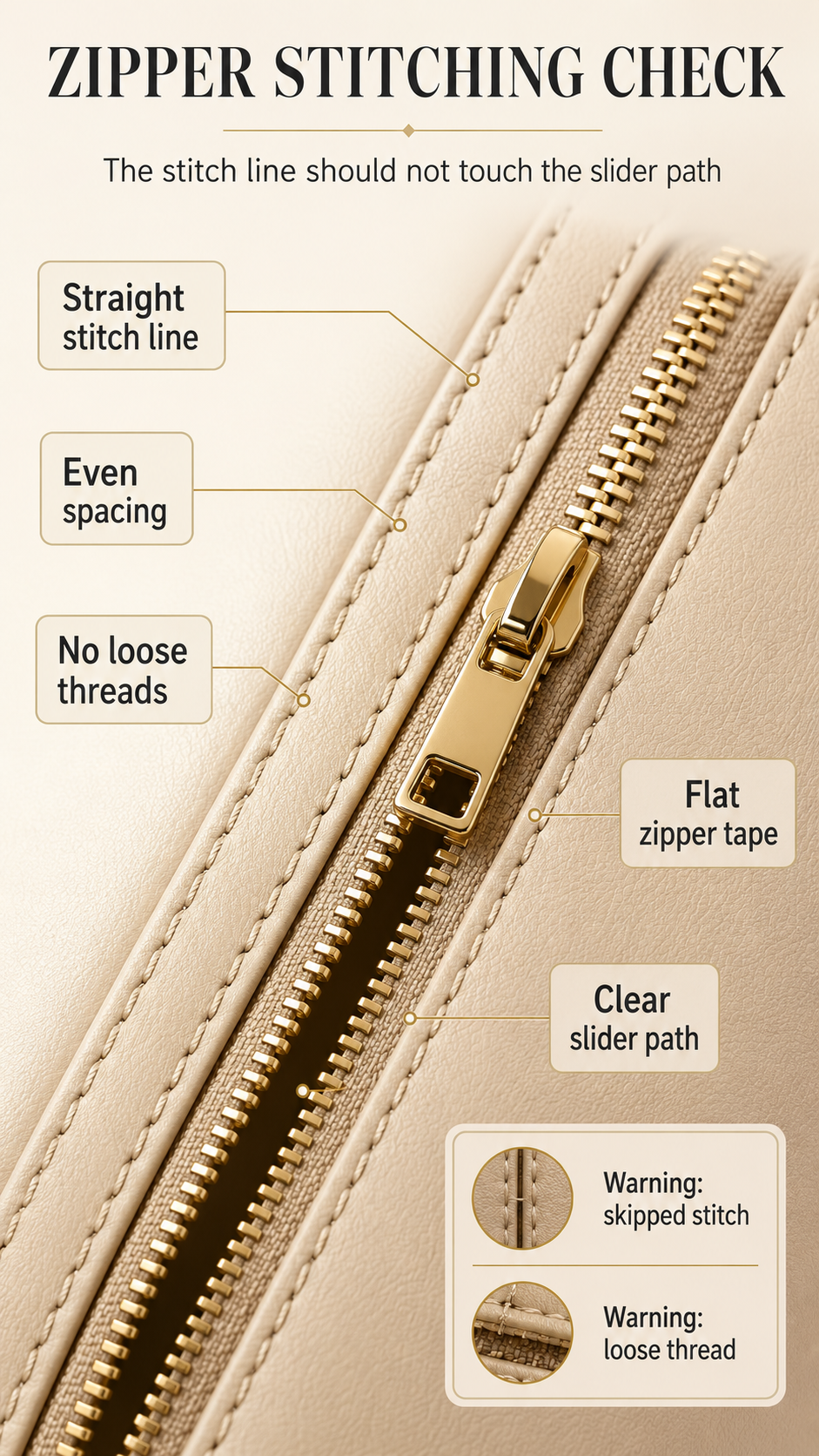
Even a good zipper can fail if it is badly sewn into the handbag. The stitch line beside the zipper should be straight, even, tight, and positioned so the slider can move without touching the thread.
Look closely at both sides of the zipper tape. The stitching should run parallel to the zipper track. If the stitch line wanders too close to the teeth, the slider may rub the thread and eventually cut it. If the stitching is loose, the zipper tape can shift and distort. If there are skipped stitches, the seam may weaken over time.
| Stitching detail | Good sign | Bad sign |
|---|---|---|
| Stitch line | Straight and parallel to zipper track | Crooked, wandering, or uneven |
| Stitch spacing | Consistent from end to end | Random long and short stitches |
| Thread tension | Thread sits secure and flat | Loose loops or thread lifting from the surface |
| Skipped stitches | No gaps in stitch sequence | Missing stitches or broken thread |
| Zipper ends | Reinforced and neatly finished | Messy knots, raw ends, or loose thread tails |
Zipper stitching is one of the easiest construction details to inspect. If the zipper stitching is careless, the rest of the bag may also have weak finishing. This is why we always recommend checking zipper stitching together with lining and stress-point stitching.
Look at the Zipper Tape and Edge Finishing
The zipper tape is the fabric strip that holds the teeth or coil. It may not be the most visible part of the bag, but it plays a major role in zipper strength and alignment. Weak tape can stretch, fray, ripple, or pull away from the bag body.
A good zipper tape should look dense, clean, and stable. It should sit flat beside the zipper. It should not look thin, gauzy, fuzzy, or full of loose fibers. Raw tape ends should be hidden, sealed, folded, or neatly secured so loose threads do not enter the slider.
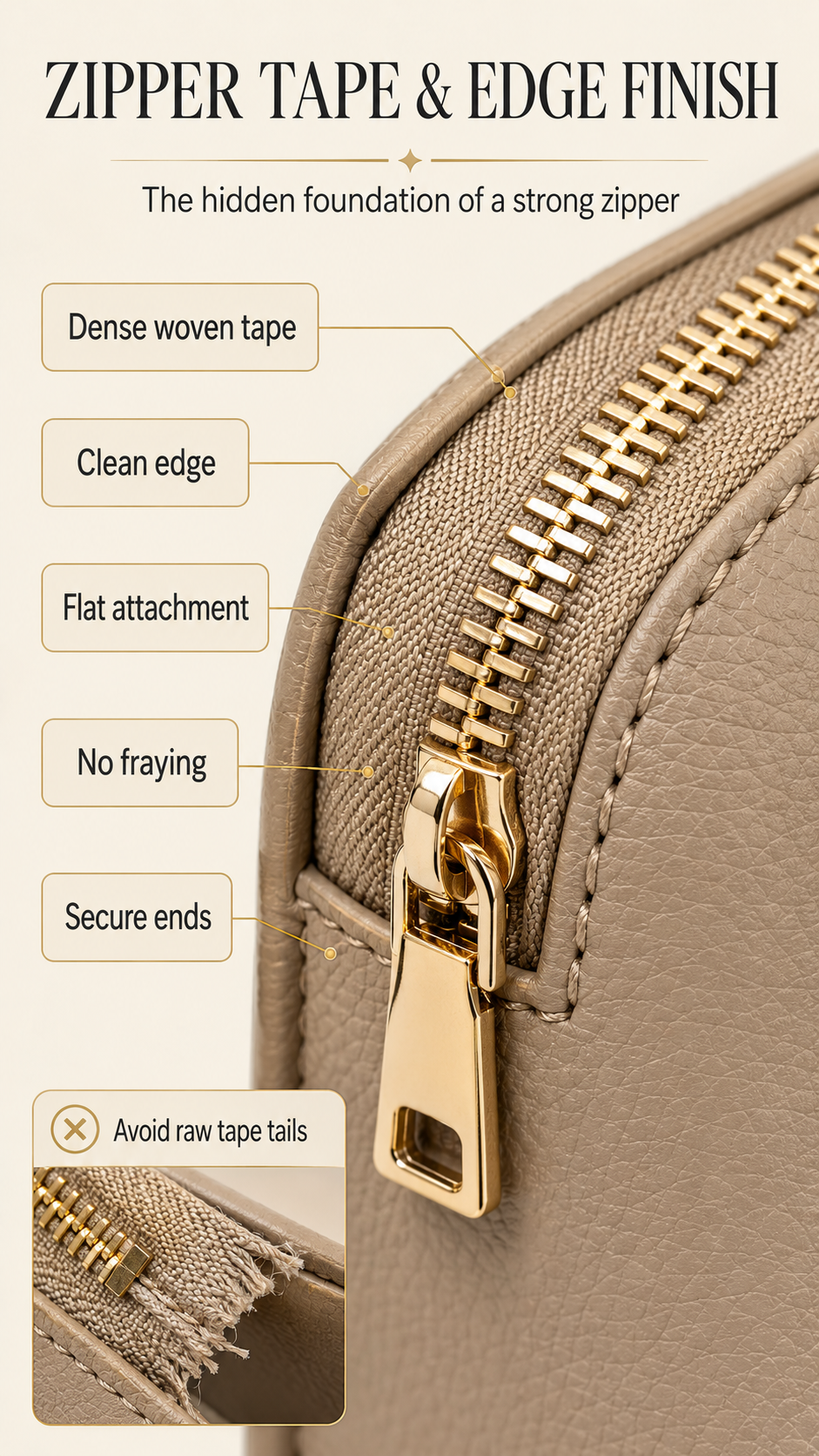
| Zipper tape area | Good quality signal | Warning sign |
|---|---|---|
| Tape texture | Dense woven fabric | Loose, thin, gauzy, or stretchy fabric |
| Tape surface | Clean and flat | Fuzzy, hairy, fraying, or rippled |
| Tape edges | Neatly finished or hidden | Raw cut ends or loose fibers |
| Tape attachment | Securely sewn to bag body | Gaps between tape and leather or lining |
| Color match | Matches or complements the bag | Looks like an obvious cheap mismatch |
Loose fibers near the zipper path are more than a cosmetic issue. They can wrap into the slider and cause a hard jam. Always inspect the ends and corners of the zipper, especially inside the bag.
Check the Interior Zipper Pocket
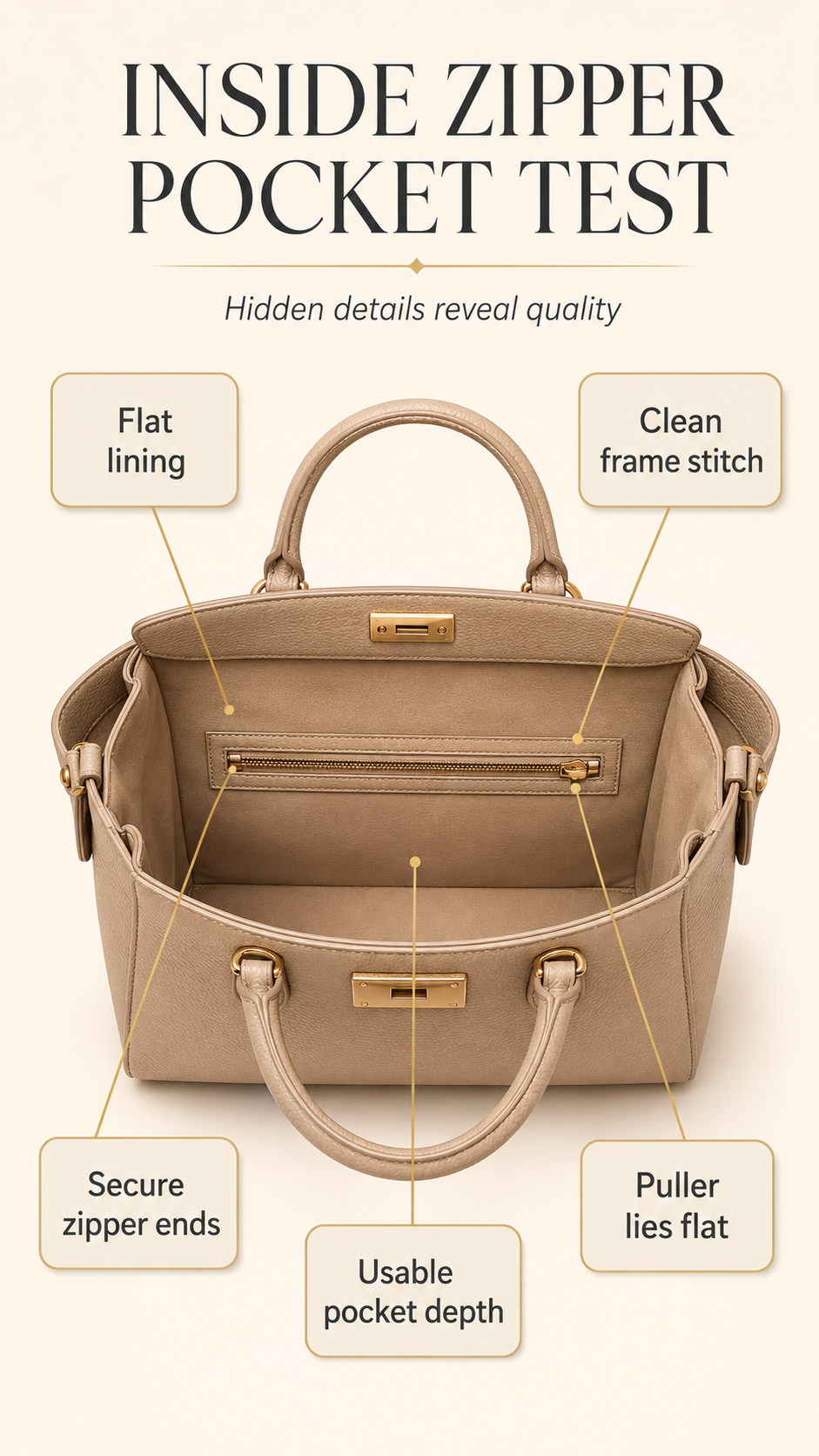
The inside zipper pocket reveals a lot about the bag’s hidden construction. Many buyers inspect the outside but ignore the interior. A well-made interior pocket should be smooth, usable, and neatly finished.
Open the bag and test the inside pocket zipper. Try to open and close it with one hand. If the lining bunches, folds, or gets pulled into the zipper, the interior construction is weak. A good pocket zipper should not require you to hold the fabric flat with your second hand every time.
| Interior zipper area | What to check | Good quality signal |
|---|---|---|
| Pocket zipper glide | Open and close the pocket several times | Moves smoothly without fabric bunching |
| Lining near track | Check whether the lining stays flat | Lining does not enter the slider path |
| Pocket frame | Look at the rectangular stitch area | Clean corners and straight stitch lines |
| Pocket depth | Place fingers inside the pocket | Useful depth for cards, keys, cash, or small items |
| Puller profile | Feel whether the puller lies flat | Does not scratch wallet, phone, or sunglasses |
Interior quality matters as much as exterior beauty. A bag with neat lining, clean pockets, and secure interior stitching usually feels more trustworthy in daily use. You can read more in our detailed guide, Bag Lining Explained.
Test Closure Security
A handbag zipper should keep the bag closed during normal movement. This is especially important for commuting, travel, shopping, and walking in crowded places. A zipper that slowly opens by itself is a security problem, not just a small annoyance.
Close the zipper fully and gently pull the bag material outward on both sides of the closed track. The teeth or coil should stay closed. Then close the zipper halfway and move the bag slightly as if carrying it. The slider should not creep open from light movement.
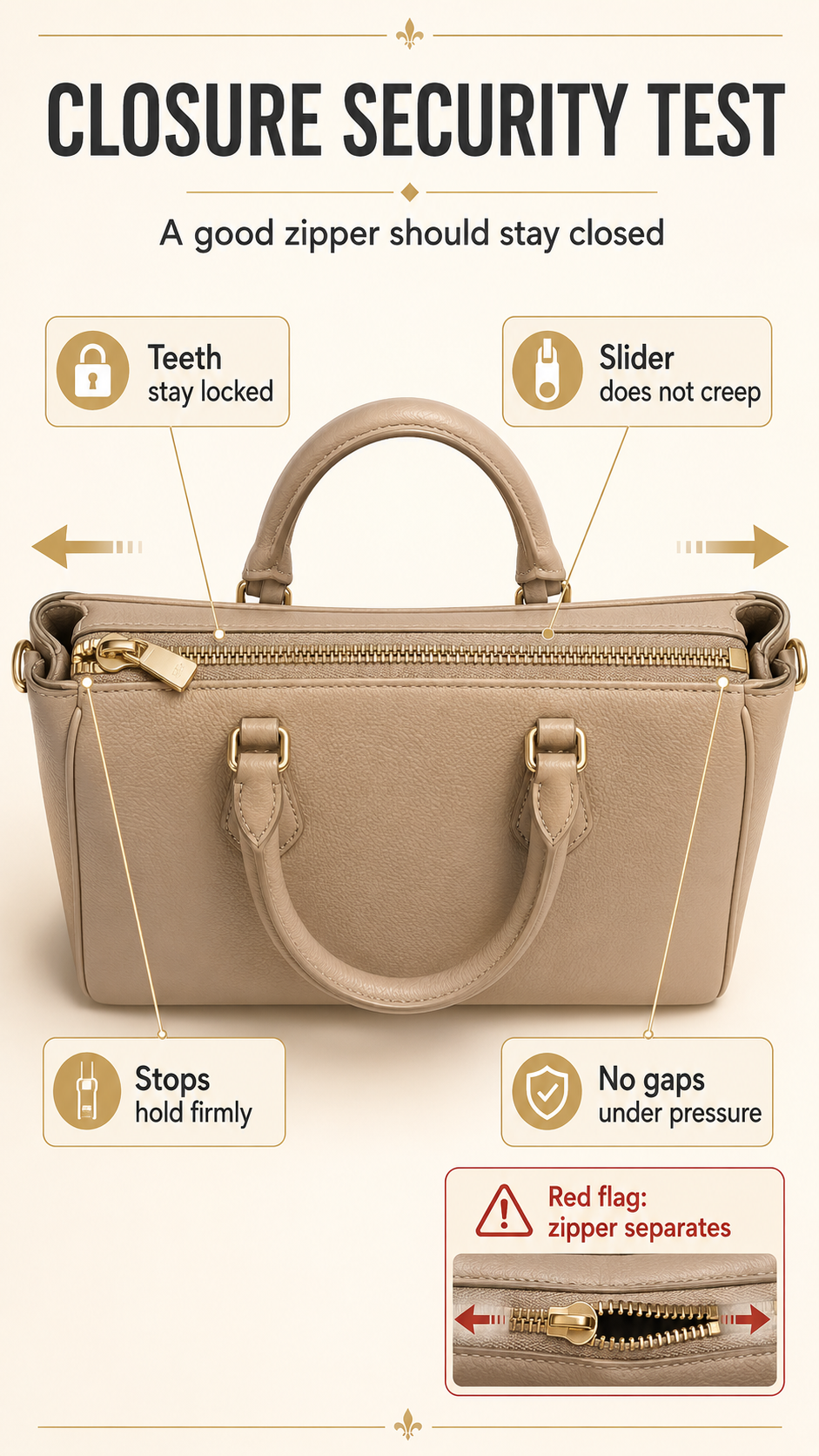
| Security check | Pass | Fail |
|---|---|---|
| Closed track pressure | Zipper stays closed | Teeth separate or show gaps |
| Walking movement | Slider stays where placed | Slider slowly creeps open |
| End stops | Slider stops securely at both ends | Slider pushes past stop or feels loose |
| Overfilled bag behavior | Zipper still closes with reasonable care | Zipper pops open behind the slider |
For daily bags, zipper security should be checked before style alone. A pretty bag that does not stay closed can become stressful during travel or commuting.
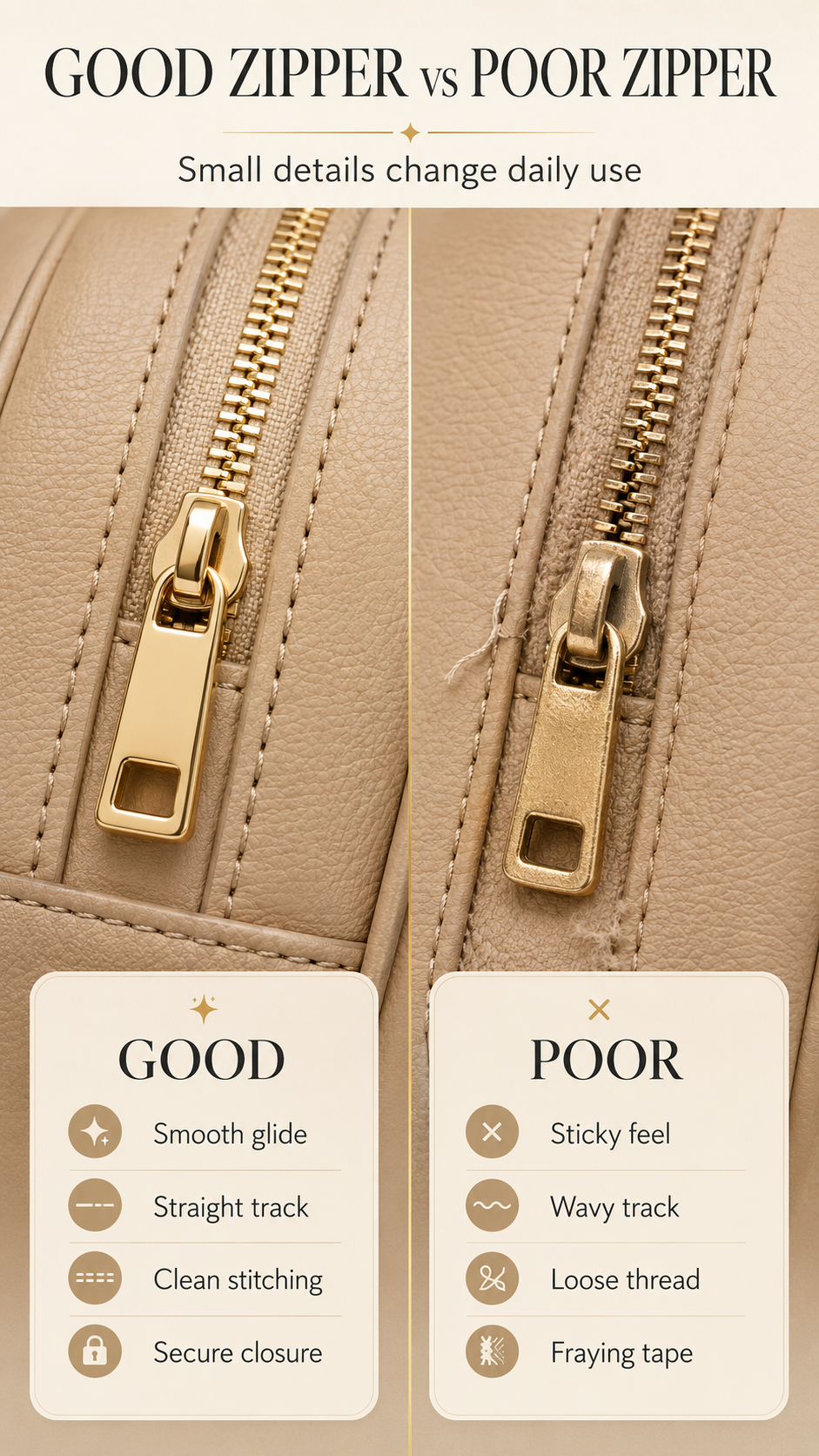
Good Zipper vs Poor Zipper
| Quality area | Good handbag zipper | Poor handbag zipper |
|---|---|---|
| Movement | Smooth, steady, controlled | Sticky, jerky, rough, or hard to pull |
| Alignment | Straight and flat when closed | Wavy, twisted, or uneven |
| Teeth or coil | Even, secure, and comfortable to touch | Sharp, broken, uneven, or distorted |
| Slider | Stable and properly fitted | Loose, wobbly, rough, or weak |
| Puller | Firm, comfortable, securely attached | Thin, sharp, flimsy, or easily bent |
| Tape | Dense, clean, flat, and neatly attached | Frayed, loose, stretchy, or raw |
| Stitching | Straight, even, and secure | Crooked, skipped, loose, or messy |
| Lining clearance | Lining stays away from zipper path | Lining gets caught in the slider |
| Security | Stays closed during normal carry | Creeps open or separates under pressure |
Common Red Flags to Avoid
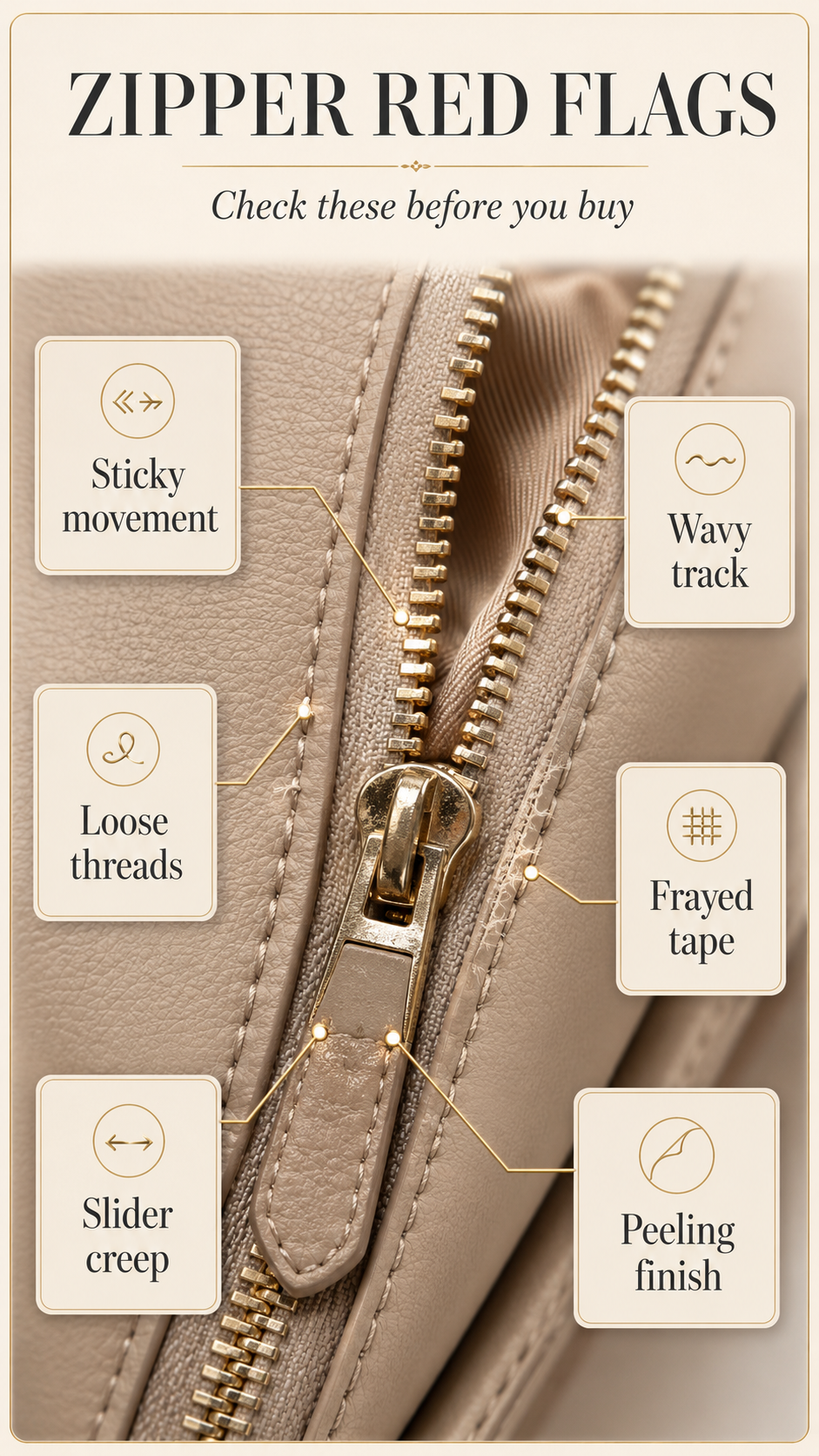
If you notice several of these problems on the same handbag, the zipper is likely a weak point:
- The zipper sticks in the same place every time.
- The slider feels loose or wobbly.
- The puller bends easily or feels sharp.
- The closed zipper line looks wavy.
- The teeth show gaps after closing.
- The metal teeth feel scratchy or jagged.
- The zipper tape looks frayed or thin.
- The stitching beside the zipper is crooked.
- There are skipped stitches or loose threads.
- The lining gets caught when closing the zipper.
- The zipper slowly opens while carrying the bag.
- The hardware finish is peeling, bubbling, or flaking.
- The zipper ends look raw, weak, or unfinished.
| Red flag | What it can mean | Why it matters |
|---|---|---|
| Sticky movement | Poor alignment, rough teeth, or weak slider fit | Can become worse with daily use |
| Wavy zipper track | Uneven sewing tension or weak tape support | Can cause jamming and separation |
| Sharp teeth | Poor finishing or polishing | Can scratch hands, lining, or wallets |
| Frayed tape | Weak woven tape or raw edge finishing | Loose fibers can jam the slider |
| Slider creep | Poor slider fit or weak locking behavior | Bag may open while walking |
| Peeling finish | Weak surface coating | Hardware can look worn quickly |
How Zipper Quality Changes Daily Use
A good zipper makes a handbag feel effortless. You can reach for your phone quickly, close the bag before walking, and access small essentials without fighting the closure. A poor zipper makes even a beautiful bag feel cheap because it interrupts your routine every day.
| Daily moment | Good zipper experience | Poor zipper experience |
|---|---|---|
| At checkout | Wallet comes out quickly | You struggle with a stuck zipper |
| During commute | Bag stays closed | Slider slowly opens while walking |
| Travel day | Passport and cards stay secure | Zipper separates or pocket jams |
| Office use | Opening feels quiet and polished | Hardware sounds harsh or rattly |
| Inside pocket use | Small items are easy to access | Lining bunches and catches |
This is why zipper quality should be considered together with lining, stitching, strap attachment, and hardware finish. A handbag is not only about how it looks in photos. It should also feel dependable when used repeatedly.
Final Buying Checklist
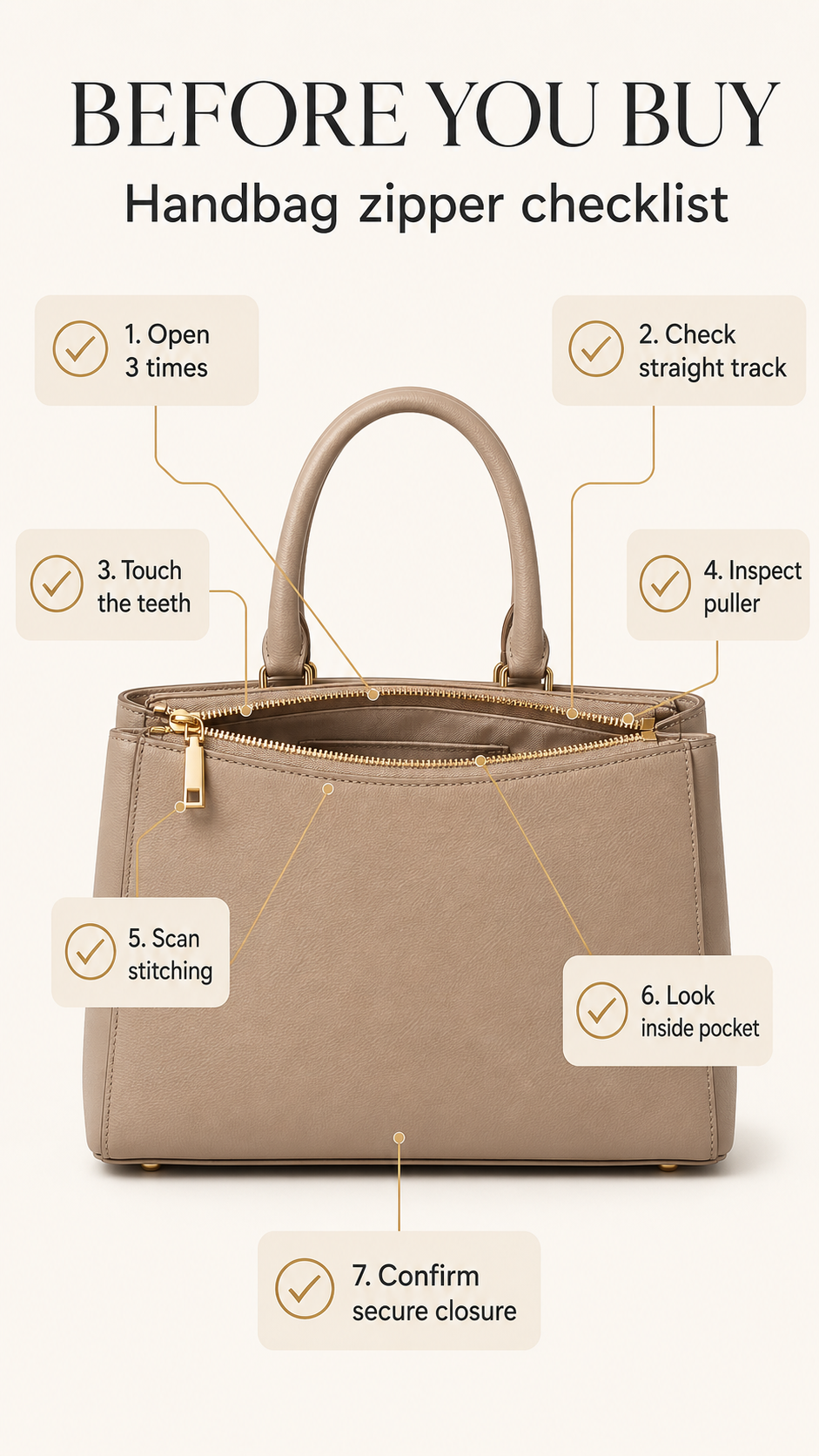
Before buying a handbag, use this simple zipper checklist:
- Open and close the zipper at least three times.
- Check whether the movement feels smooth from end to end.
- Look straight down at the closed zipper track.
- Make sure the line is straight, not wavy.
- Touch the teeth or coil carefully to check smoothness.
- Inspect the puller and slider for stability.
- Check the zipper tape for fraying or loose fibers.
- Look at the stitching beside the zipper.
- Test the inside zipper pocket if the bag has one.
- Make sure the lining does not get caught.
- Confirm that the zipper stays closed during light movement.
- Check both zipper ends for secure finishing.
Final Verdict
A good handbag zipper should feel smooth, secure, aligned, and well-integrated into the bag. It should open without force, close without gaps, sit straight on the bag, and stay clear of the lining. The puller should feel comfortable, the slider should feel stable, the tape should be clean, and the stitching should look intentional.
If the zipper is sticky, sharp, wavy, loose, poorly stitched, or already showing peeling finish, treat it as a serious quality warning. A weak zipper can make a beautiful handbag difficult to use, especially for everyday routines like commuting, shopping, office carry, and travel.
The best rule is simple: do not judge a handbag only by its outside. Open it. Close it. Touch the zipper. Listen to it. Look inside. A trustworthy handbag should feel considered everywhere, from the exterior shape to the smallest interior zipper pocket.