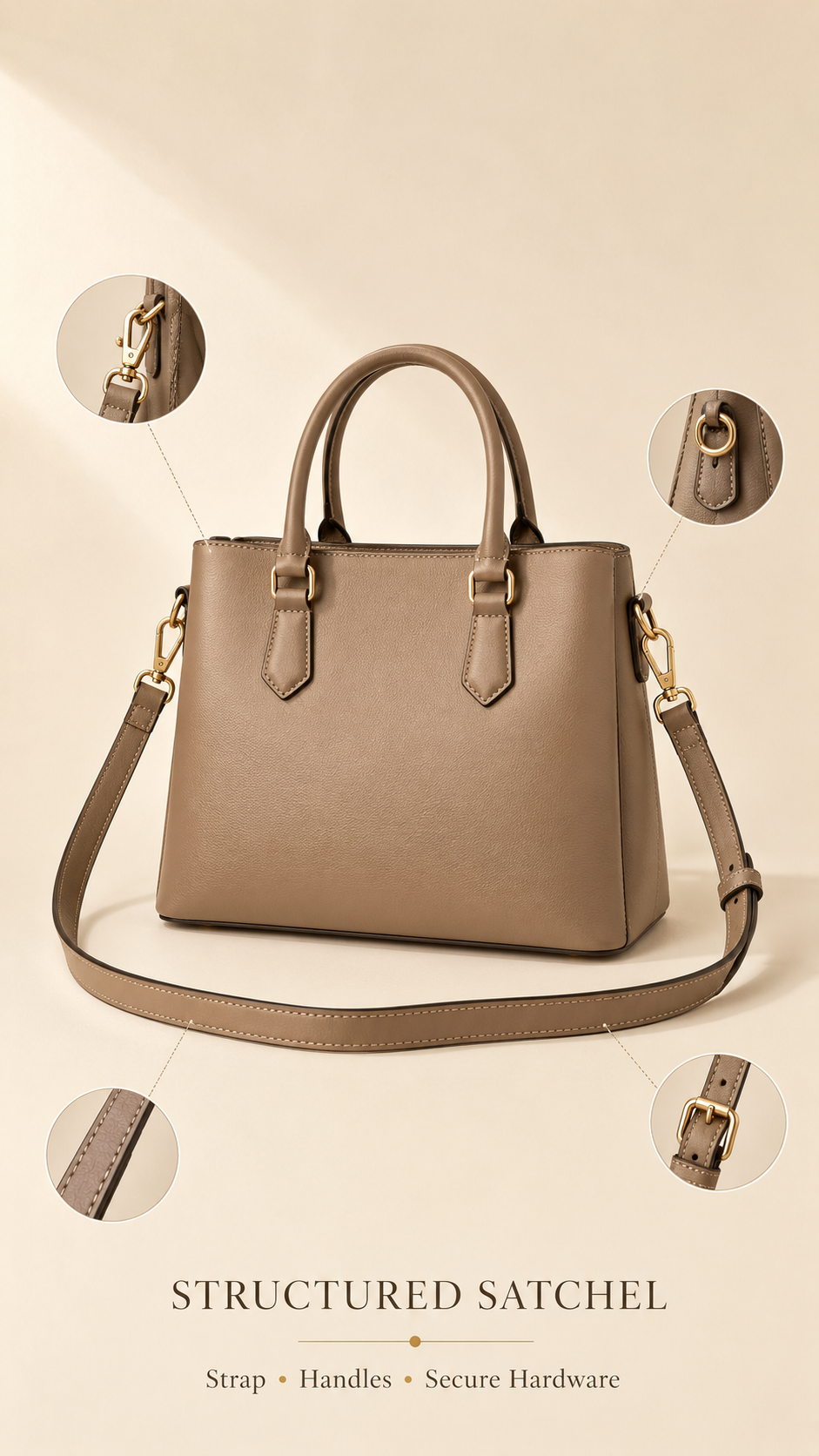
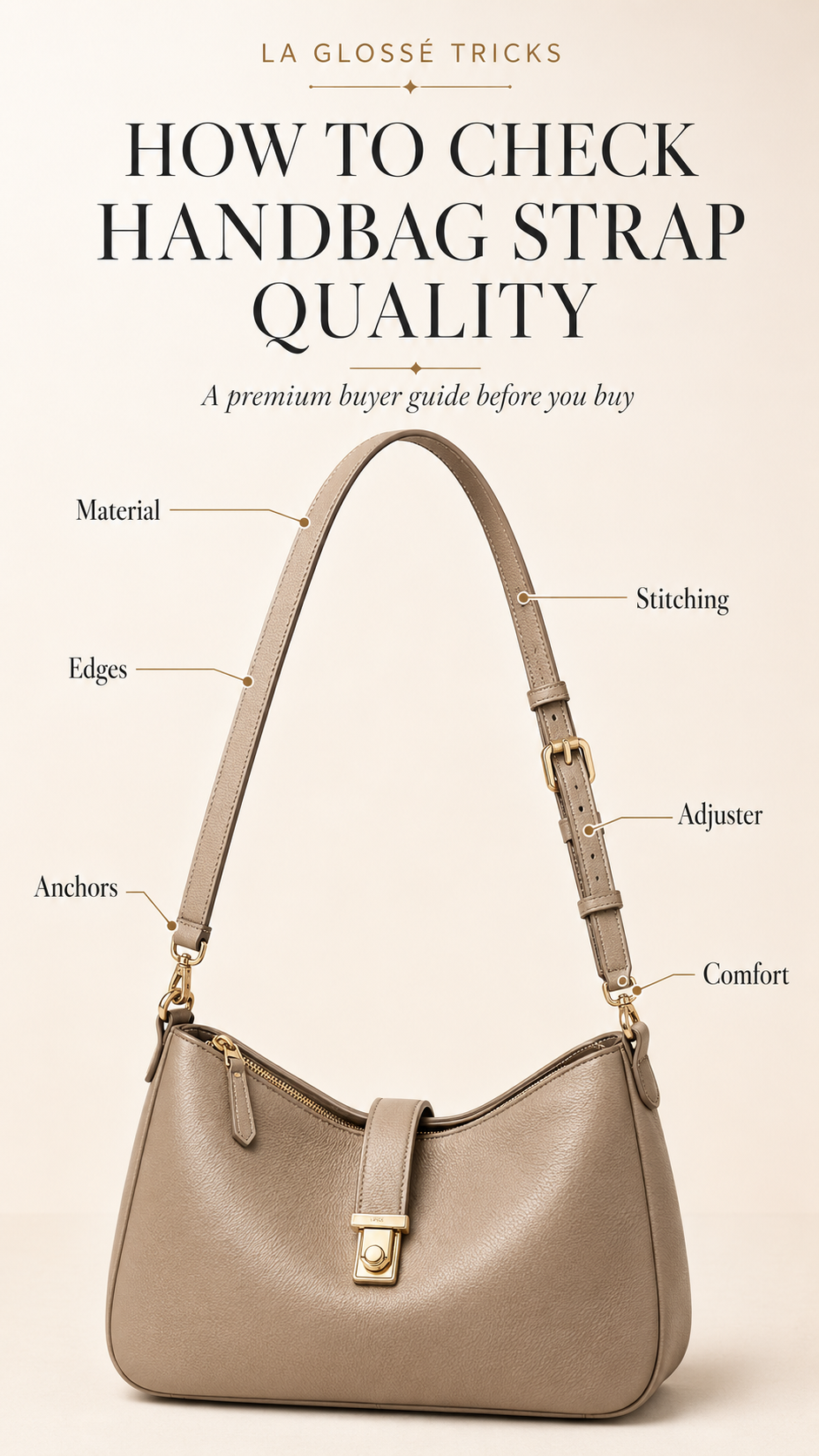
The Strap Is the Real Stress Line of the Bag
A handbag strap carries the physical load of the bag and transfers that weight to your hand, shoulder, or across your body. That is why strap quality affects comfort, balance, movement, and long-term usability.
A beautiful bag with a weak strap can feel disappointing after only a few uses. Look beyond the color and silhouette. A good strap should feel stable, flexible, smooth at the edges, secure at both ends, and comfortable enough for the way you plan to carry it.
Carry Security
Hooks, rings, tabs, rivets, and stitching should feel stable when the strap is gently pulled.
Daily Comfort
The strap should not dig, slide constantly, twist at the neck, or feel sharp on the shoulder.
Long-Term Wear
Clean edges, tight stitches, and strong adjustment points help the strap age better with normal use.
For a complete buyer inspection, combine this strap guide with the handbag hardware quality guide, the handbag zipper quality guide, the handbag stitching quality checklist, and the bag lining guide.
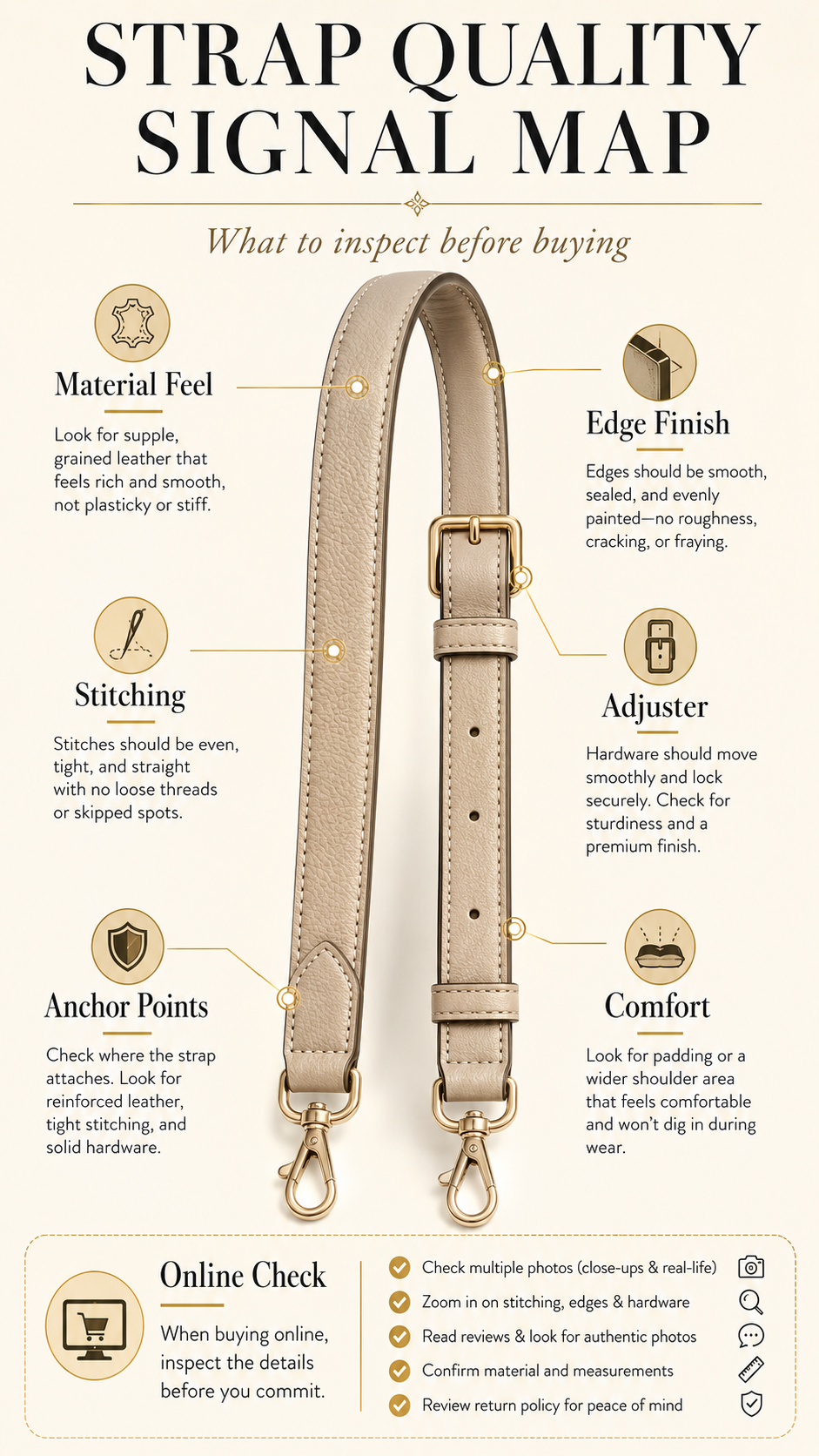
LA GLOSSÉ Strap Quality Scoreboard
Not every strap detail has the same importance. Decorative appearance matters, but the highest priority should be the areas that affect comfort and carry security.
Material Board: What the Strap Is Made From
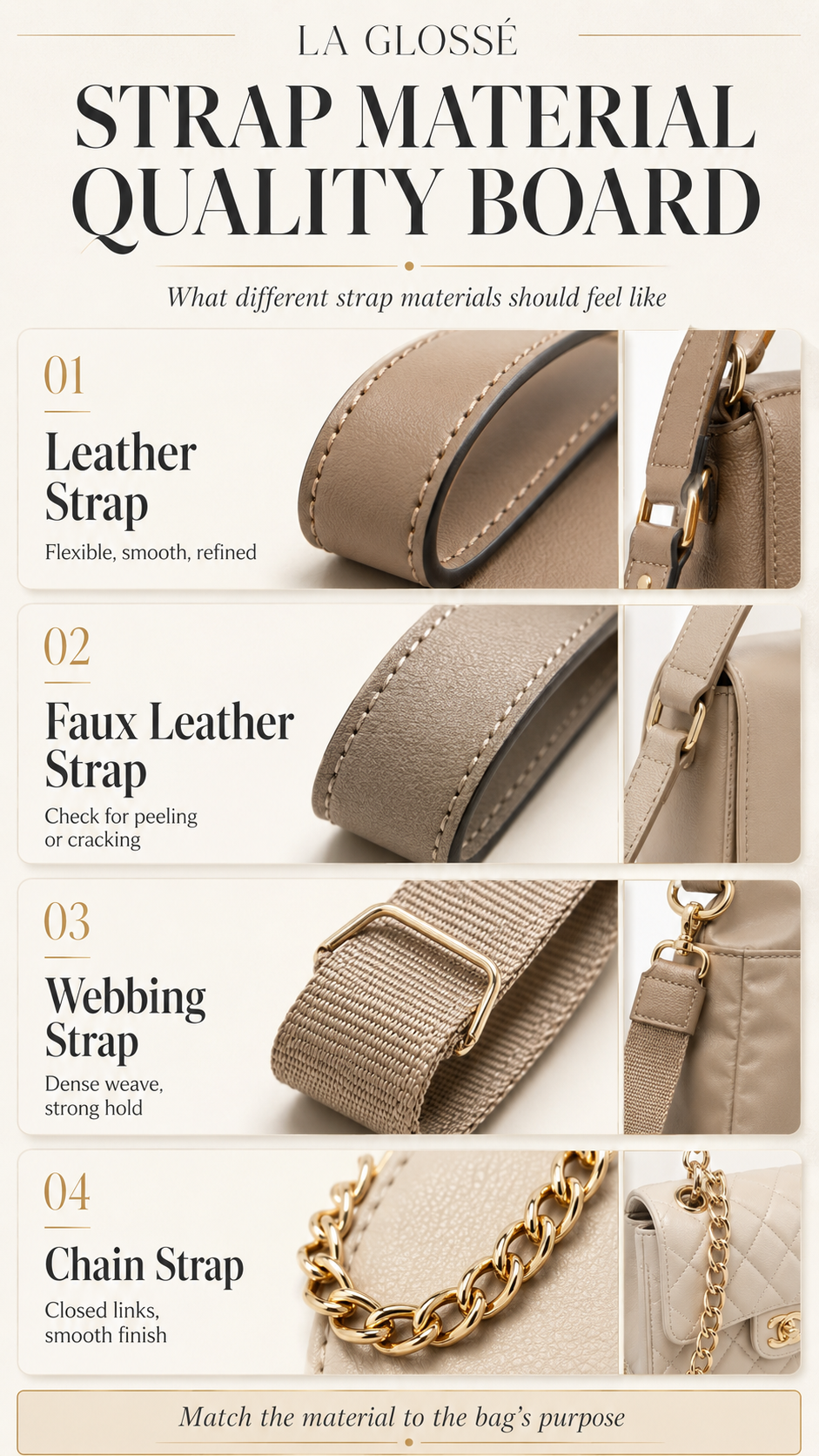
Different strap materials behave differently. Leather, faux leather, canvas, fabric webbing, nylon webbing, and chain straps can all work when the construction matches the bag size and use case.
When the product description is unclear, treat material claims carefully. If a listing says “PU,” “vegan leather,” “faux leather,” or “man-made,” inspect it as a synthetic material unless the seller clearly states otherwise.
Leather Strap
Look for natural flexibility, clean surface finish, smooth edges, and no cracking when gently bent.
Faux Leather Strap
Check for peeling, sticky coating, stretched holes, cracking corners, and vague material wording.
Webbing Strap
Look for dense weave, strong folded ends, clean side borders, and no loose yarns.
Chain Strap
Check closed links, smooth finish, no sharp seams, and comfortable weight for the bag size.
| Strap Material | Best Buyer Use | Quality Check | Main Caution |
|---|---|---|---|
| Leather | Satchels, shoulder bags, refined daily bags | Smooth grain, flexible feel, sealed edges | Needs clear material labeling and proper care |
| Faux leather or PU | Affordable fashion bags and light daily use | No peeling, no sticky surface, no cracking holes | Surface coating may wear differently by model |
| Nylon or polyester webbing | Crossbody, travel, utility, casual carry | Dense weave, strong slider grip, clean ends | Low-quality webbing may fray or stretch |
| Canvas or cotton webbing | Casual shoulder bags and relaxed totes | Thick weave, no fuzzy edges, clean color finish | May absorb moisture or show wear with friction |
| Metal chain | Evening bags, compact shoulder bags, dressy styles | Closed links, smooth plating, no sharp seams | Can feel uncomfortable if heavy or unpadded |
Edge Finish Is Where Poor Straps Reveal Themselves
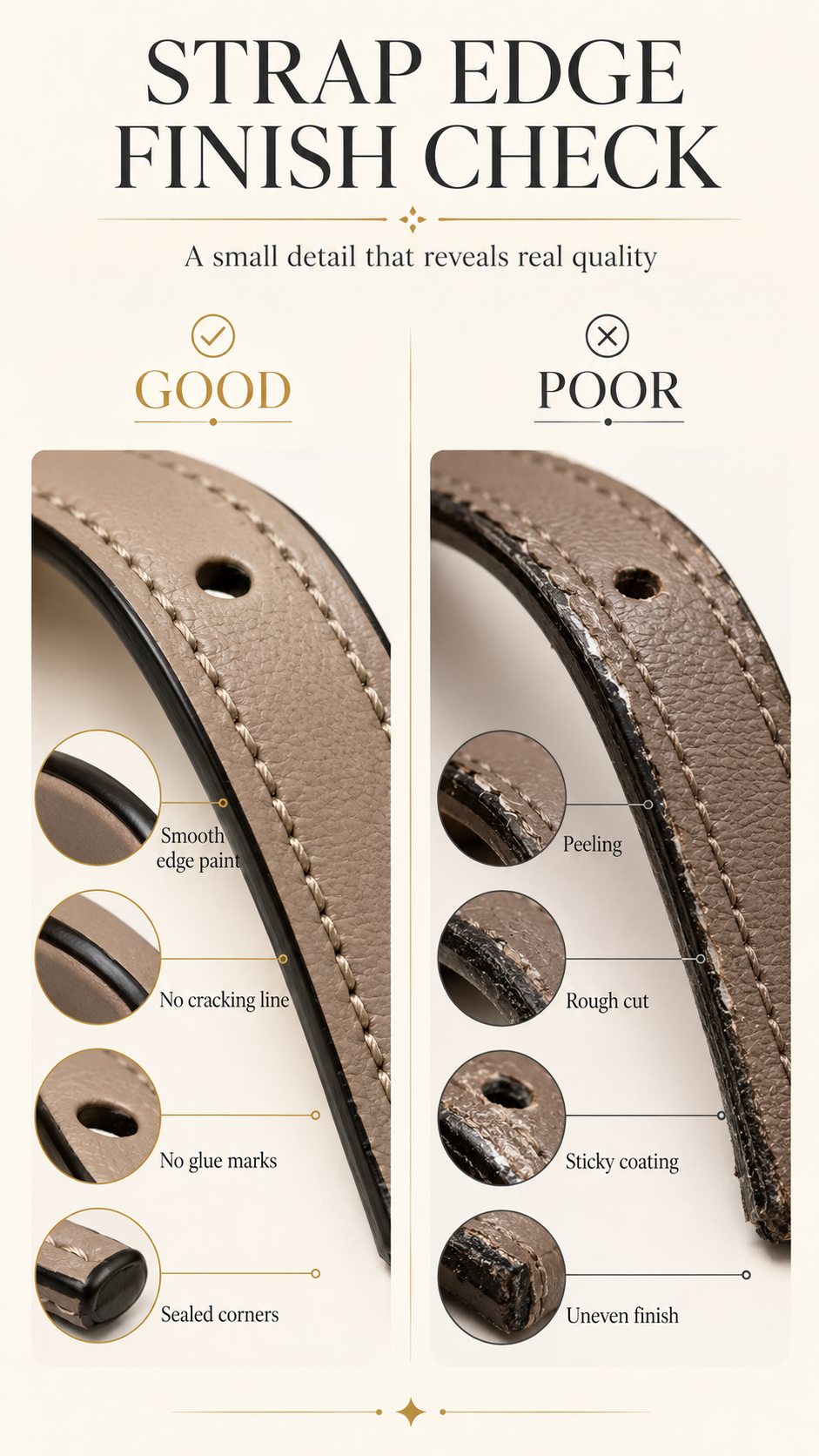
Strap edges rub against your hand, shoulder, clothing, and hardware. A good edge should feel smooth, sealed, dry, and even. A poor edge may show peeling, rough cuts, visible glue, fuzzy fibers, sticky edge paint, or uneven coating.
Smooth Edge Paint
The finish should feel level and dry, not gummy, thick, rubbery, or bubbly.
No Cracking Line
When gently bent, the edge should not split, flake, or show a sharp fracture line.
No Glue Marks
Crusty glue near the seam or side border can make the strap look rushed and unfinished.
Sealed Corners
Tips, curves, and adjustment holes should not expose raw inner layers.
| Edge Area | Premium Signal | Reject Signal |
|---|---|---|
| Side border | Flat, smooth, dry finish | Sticky, bubbling, peeling, or rubbery paint |
| Corner tip | Fully sealed around the curve | Open layers or raw cut corner |
| Buckle hole | Clean round shape with no tearing | Oval, ragged, cracked, or stretched hole |
| Layer line | Layers sit flush together | Splitting, lifting, glue gap, or visible separation |
Strap Stitching: Check the Ends Before the Middle
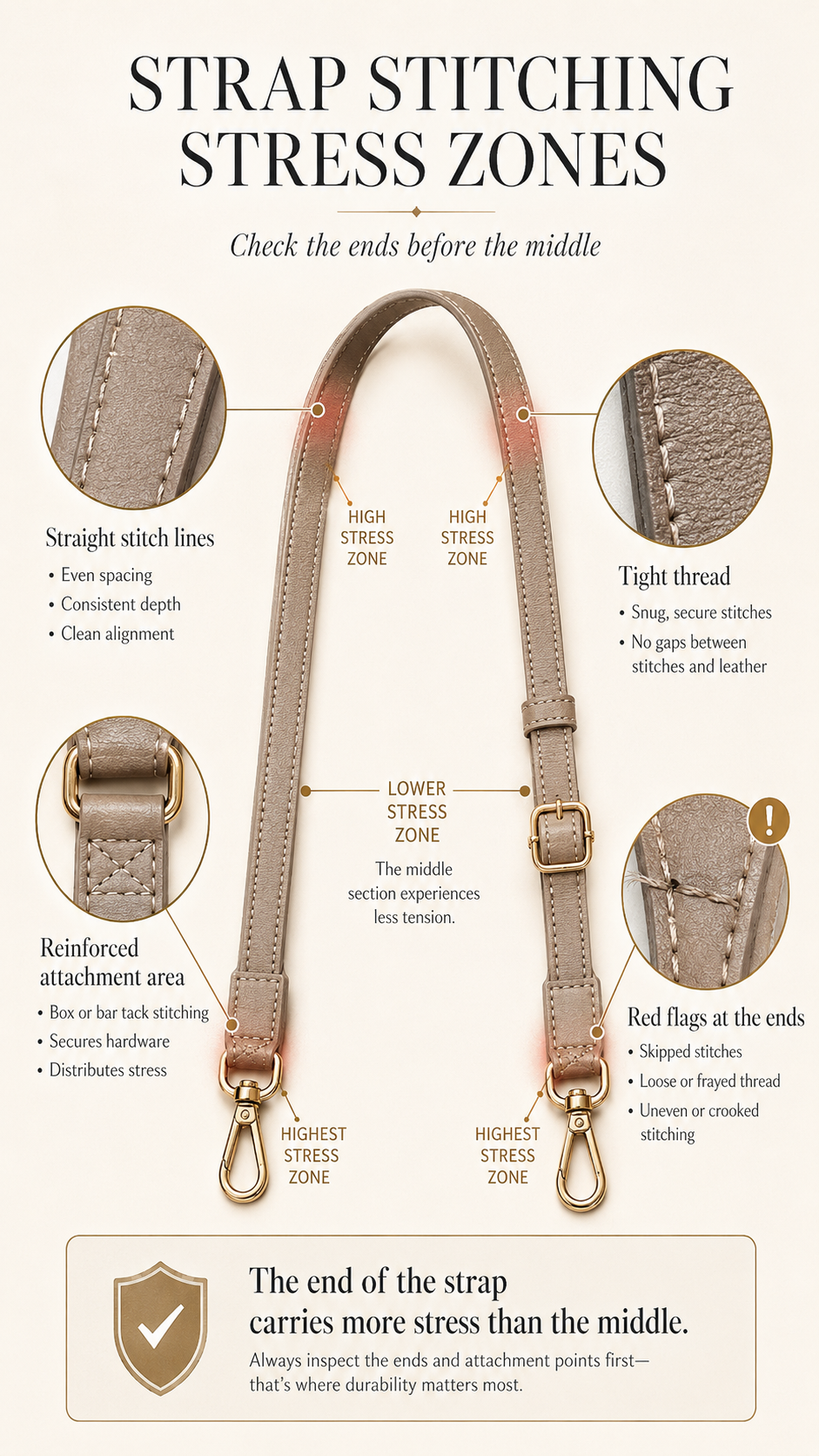
The strap may have neat stitching down the center, but the most important stitching is near the ends. The ends handle repeated tension, bending, and movement around hardware.
Look for straight stitch lines, tight thread, no skipped stitches, no loose thread tails, and reinforcement near attachment points. The end of the strap carries more stress than the middle, so both ends deserve close inspection.
Strap Ends
Check for tight finishing, backstitching, and no dangling thread.
Hardware Fold
The folded section around rings or buckles should not rely on one fragile stitch line.
Underside
Flip the strap and check for messy loops, loose knots, or uneven tension.
For a deeper full-bag stitch inspection, use the handbag stitching quality guide.
Attachment Points Decide Whether the Strap Feels Safe
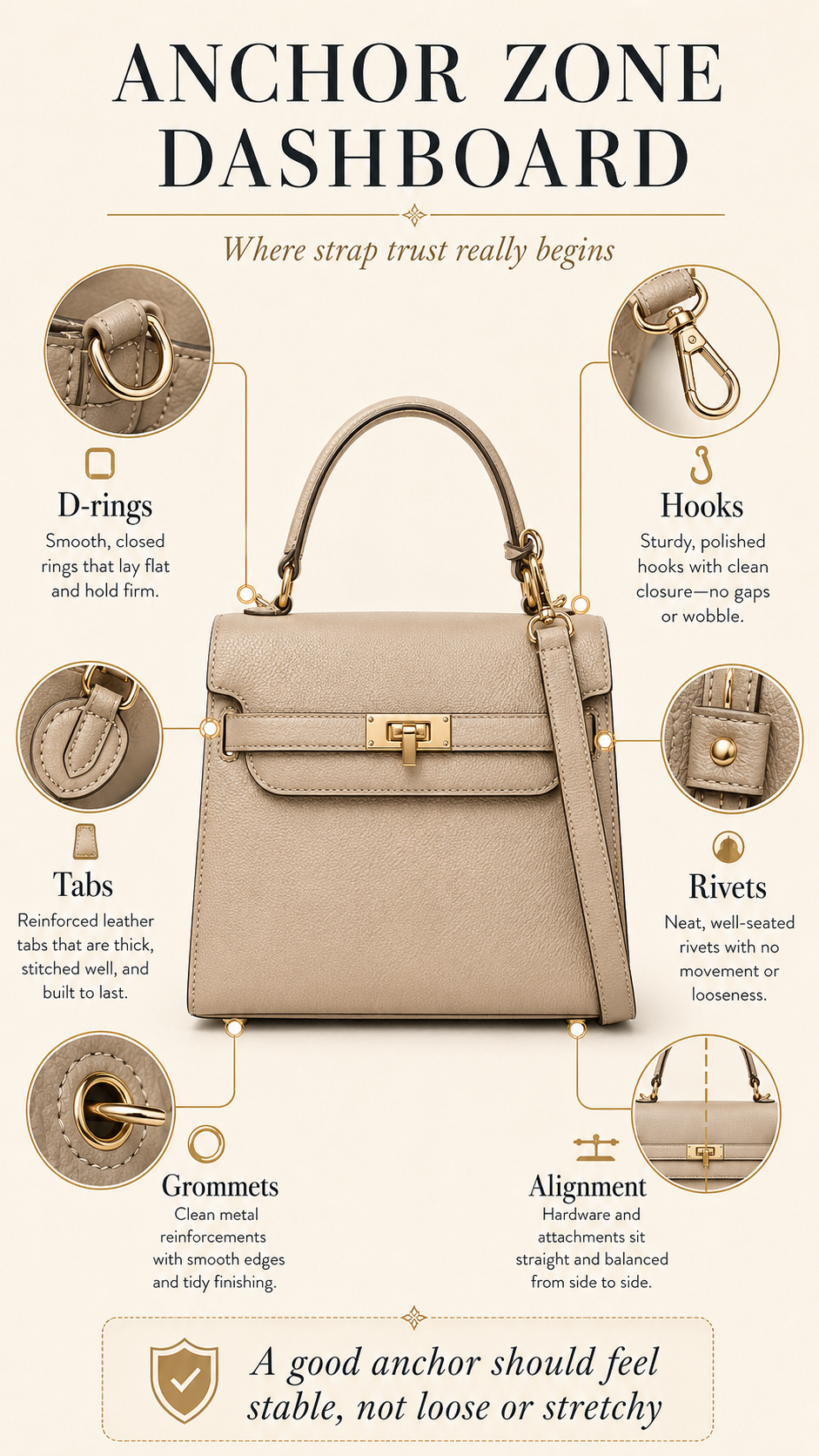
The attachment point is where the strap connects to the handbag body. This can include D-rings, O-rings, hooks, loops, stitched tabs, rivets, grommets, chain loops, or permanent handle anchors.
Hold the bag body with one hand and gently pull the strap with the other. A good connection should feel stable, not loose, stretchy, or spongy. The tab should not pull away from the bag wall, and the surrounding panel should not pucker sharply.
D-Rings & O-Rings
Should feel appropriate for the bag size, with no rough edges or visible opening gaps.
Hooks & Clasps
Should close securely and move smoothly without weak spring action.
Stitched Tabs
Should stay flat against the bag body during a gentle pull test.
Rivets
Should look centered, tight, and not loose against the material.
Grommets
Should not spin freely, scrape the strap, or expose fraying.
Alignment
The strap should hang naturally without twisting the hardware sideways.
For metal finish, clasp movement, plating, and ring quality, compare this with the handbag hardware quality guide.
Adjuster and Shoulder Comfort Check
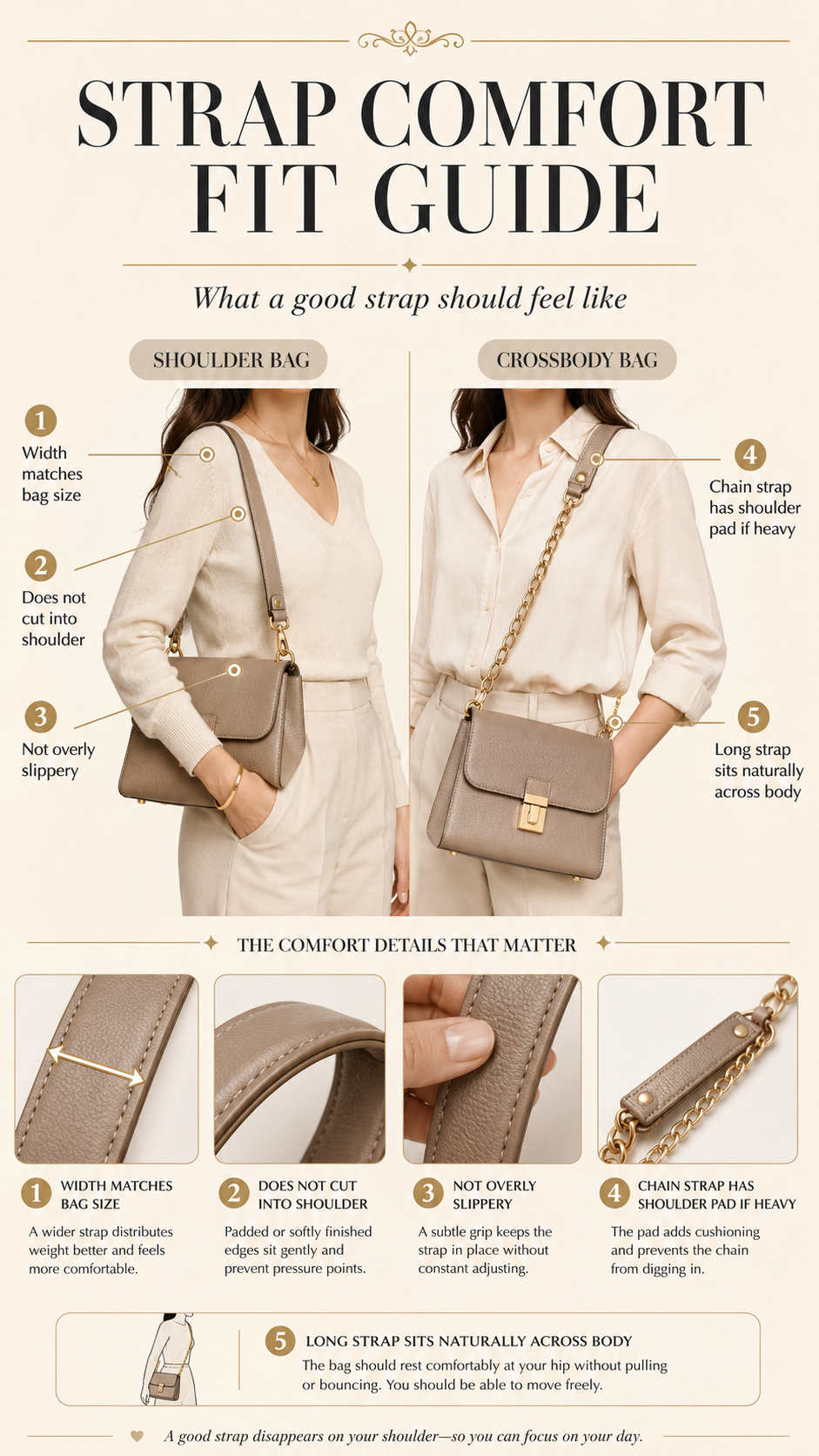
Adjustable straps are useful because they help the bag sit better on different body heights, clothing layers, and carry preferences. But the adjuster must hold the selected length during normal wear.
For buckle straps, inspect the hole shape and prong stability. For slider straps, set the length and pull gently below the adjuster. For chain-through straps, check whether the chain moves smoothly without scraping the grommets.
Adjuster Quality
Buckle Holes
Clean, round, evenly placed, and not stretched.
Slider Grip
Holds the strap length without drifting down.
Buckle Frame
Feels firm and does not bend easily under finger pressure.
Hardware Placement
Should not sit sharply on top of the shoulder or collarbone.
Comfort Signals
Width Match
Larger bags usually need stronger or wider strap support.
No Cutting Edge
The strap should not feel sharp at the shoulder or underarm.
Balanced Grip
It should not slide off constantly or feel sticky on clothing.
Natural Crossbody Line
The strap should sit flat across the torso without twisting at the neck.
If you prefer hands-free carry, compare strap fit with a utility crossbody bag for travel, a mini crossbody phone bag, or a quilted messenger bag for women.
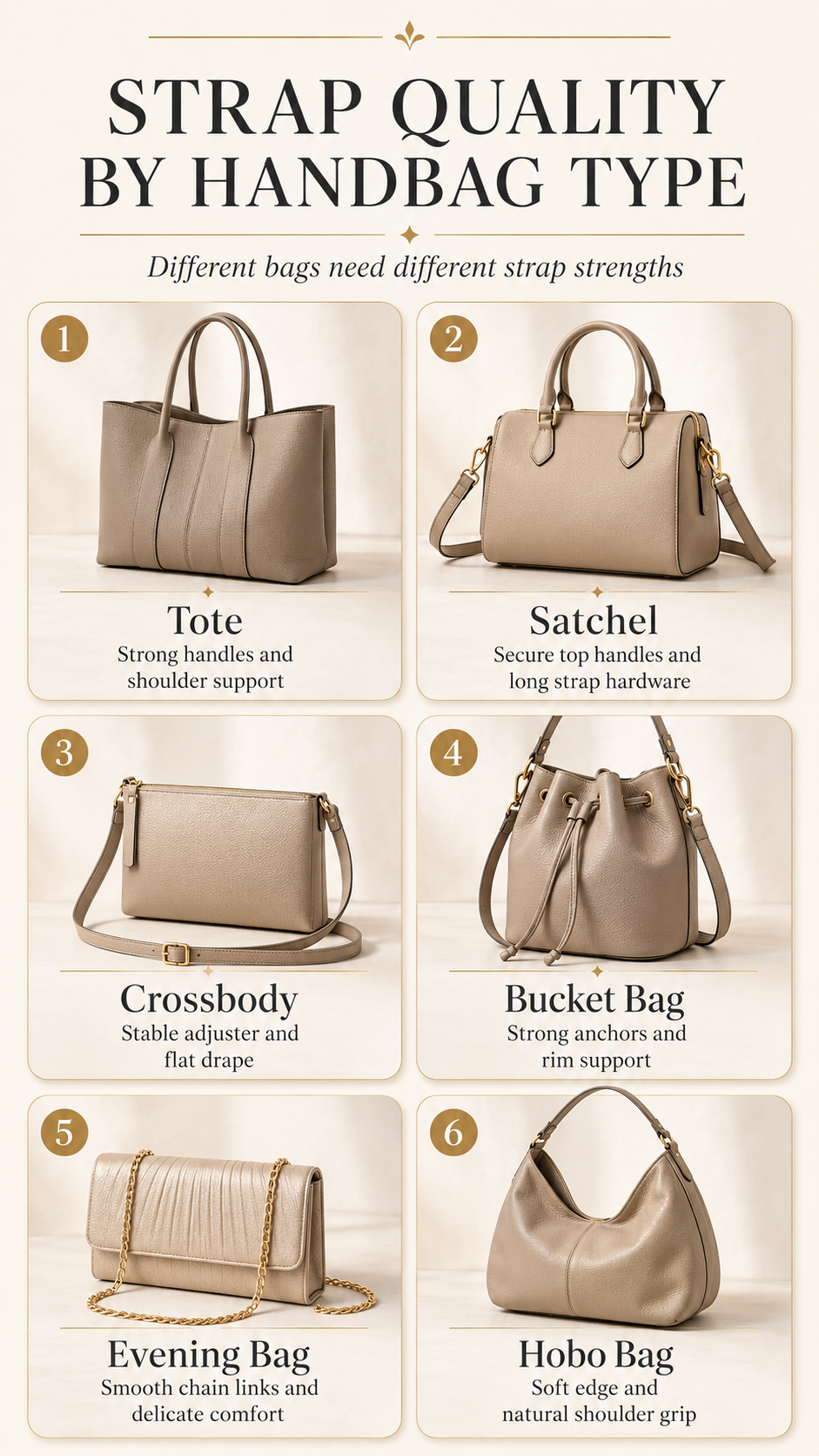
Strap Quality by Handbag Type
Different handbag silhouettes place stress on different strap areas. A tote needs strong handles. A satchel needs both handle support and long-strap security. A crossbody needs adjustability. A bucket bag needs stable side anchors. An evening bag needs smooth chain links.
Tote Bags
Check handle bases, shoulder width, stitching at tabs, and whether the handles feel strong enough for normal daily items.
Satchel Bags
Check top handles, side D-rings, removable strap hooks, and whether the long strap feels secure when lifted.
Crossbody Bags
Check adjuster hold, strap drop, swivel hooks, and whether the strap lies flat across the torso.
Bucket Bags
Check side anchors, top-rim structure, grommets, and whether the strap pulls the opening out of shape.
Evening Bags
Check chain smoothness, link closure, tiny ring strength, and whether the chain catches on delicate fabric.
Hobo & Shoulder Bags
Check shoulder drop, strap grip, underarm comfort, and whether the strap stays naturally in place.
| Bag Type | Main Strap Stress Point | Best Quality Signal | Common Red Flag |
|---|---|---|---|
| Tote | Handle base and shoulder load | Wide reinforced tabs and strong stitching | Thin handles stitched with one weak line |
| Satchel | Top handle plus long strap hardware | Firm handle shape and stable D-rings | Loose hook, collapsed handle, or weak side ring |
| Crossbody | Adjuster and torso movement | Secure slider or buckle with flat drape | Slipping slider or twisting strap |
| Bucket | Side anchor and top-rim pull | Stable tabs, rivets, or reinforced grommets | Rim puckering or loose eyelets |
| Evening | Small chain links and delicate contact | Smooth closed links and secure rings | Sharp chain edges or open link gaps |
| Hobo | Shoulder drop and strap grip | Soft edge with stable shoulder placement | Overly slippery strap that keeps falling |
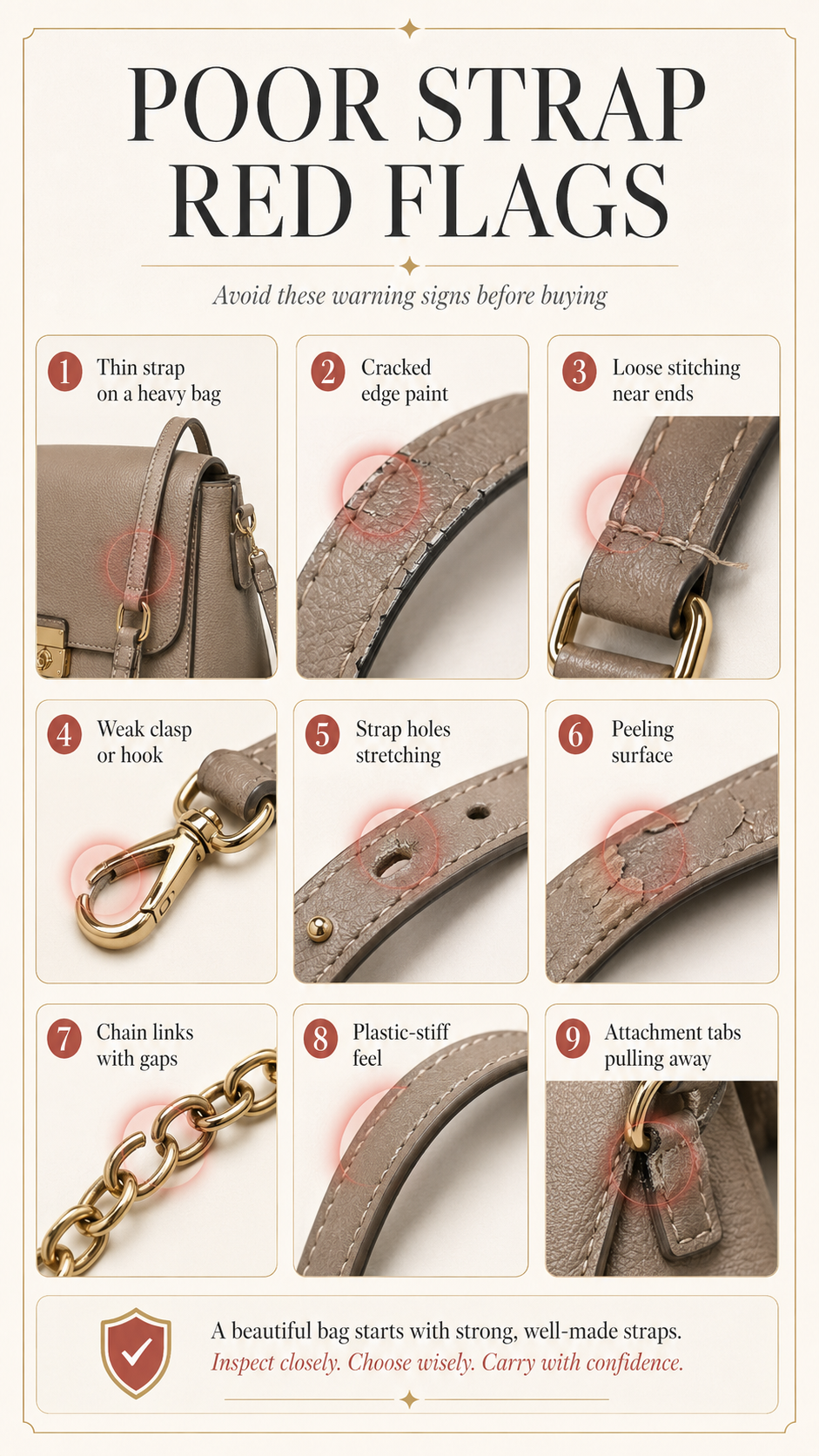
Do Not Ignore These Strap Warning Signs
Some strap details are style choices. These are not. If a bag shows several of these signs before purchase, it may not be the best option for regular daily use.
Thin Strap on a Heavy Bag
The strap may feel uncomfortable and can put too much stress on small anchor points.
Cracked Edge Paint
Cracks can spread, expose inner layers, and create peeling or rough contact.
Loose Thread Near Ends
Loose thread near attachment zones is more serious than decorative loose thread.
Weak Clasp or Hook
A clasp should close cleanly and should not feel thin, rough, or hollow.
Stretched Strap Holes
Oval holes suggest the material may not hold adjustment well over time.
Peeling Surface
Peeling is difficult to reverse and often worsens with friction and use.
Chain Links With Gaps
Open links can pull apart, snag fabric, or feel rough on the shoulder.
Plastic-Stiff Feel
Overly stiff straps may cut into the shoulder and crease badly when bent.
Tabs Pulling Away
If the tab lifts from the body during a gentle pull, the anchor may be weak.
Slipping Adjuster
A slider that drifts down makes the bag hang lower while walking.
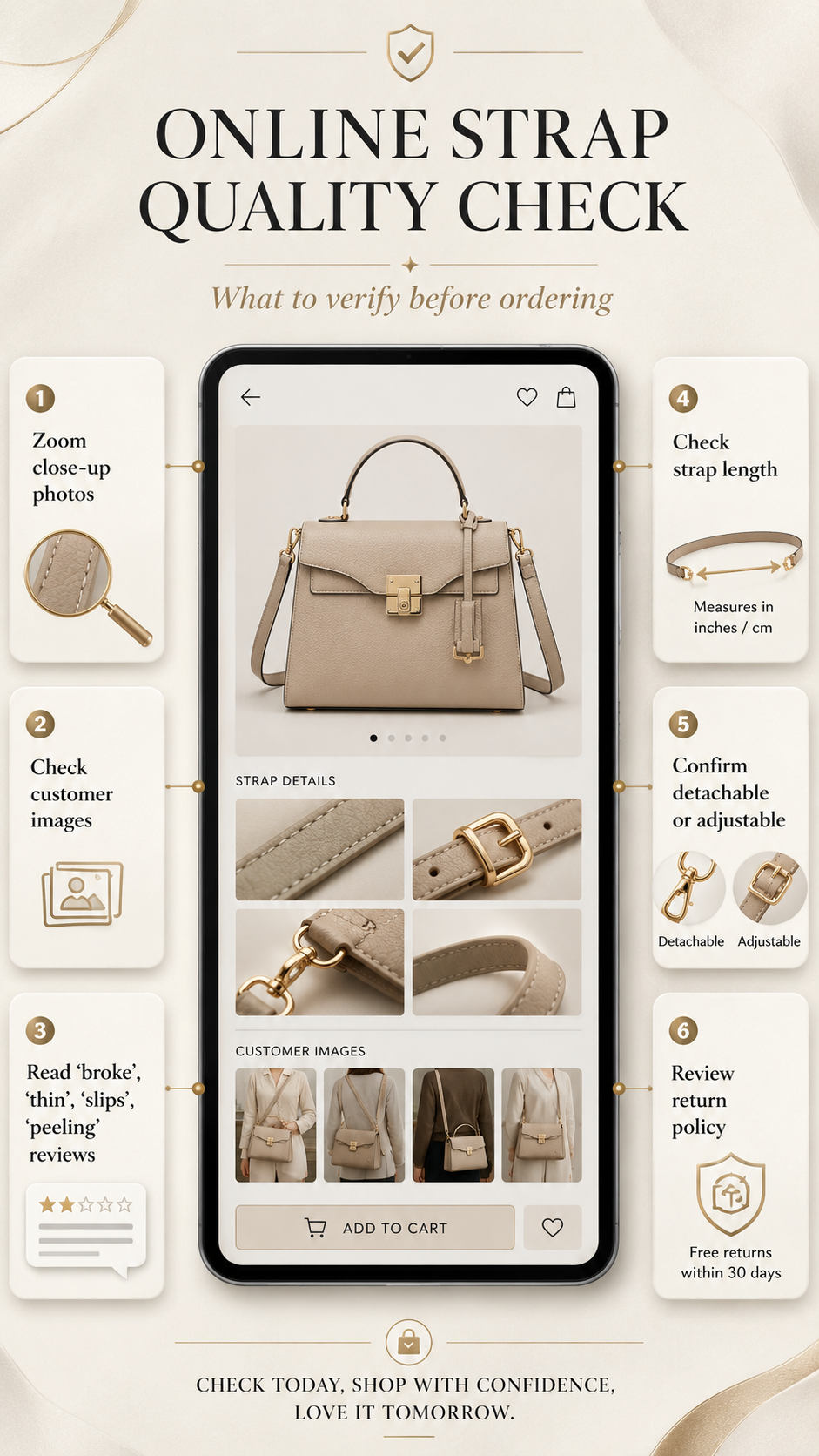
How to Check Strap Quality When Shopping Online
Online shopping removes the hand-feel test, so you need to inspect photos, specifications, customer images, review patterns, and return terms. A good product page should make strap details easy to understand.
Photo Zoom
Look for clear close-ups of strap edges, hooks, rings, tabs, and adjusters.
Customer Images
Check real drape, strap thickness, natural fit, and early wear signs.
Review Keywords
Search for repeated mentions of breaking, peeling, slipping, or discomfort.
Specifications
Confirm strap length, strap drop, material, adjustability, and detachable design.
Return Safety
If strap quality is unclear, review the return policy before checkout.
Fit Support
For proportion decisions, use the LA GLOSSÉ size guide.
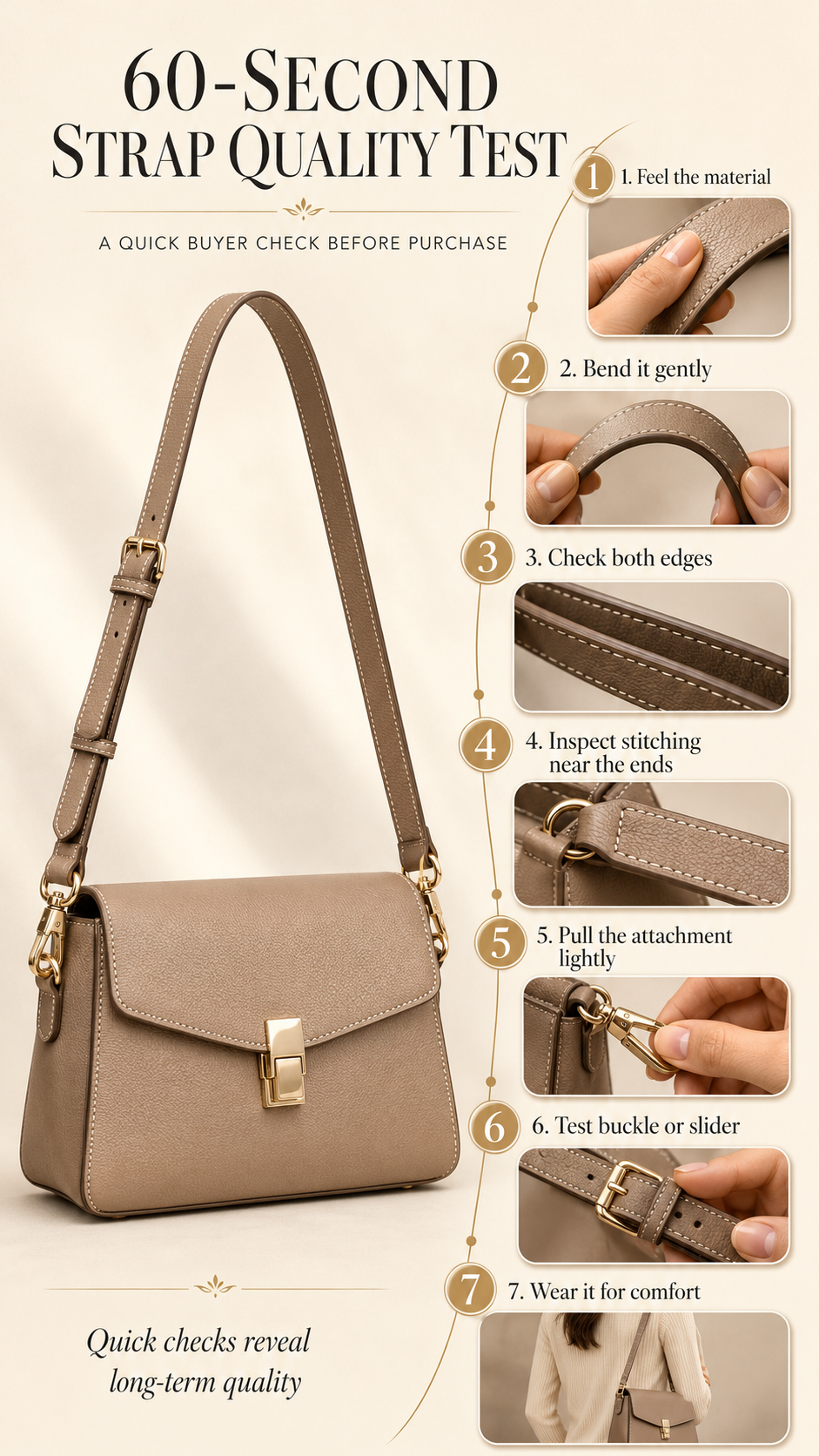
The 60-Second Handbag Strap Quality Test
Use this quick test in store or after delivery. Keep it gentle. You are checking quality signals, not trying to damage the product.
Feel the Material
Check whether the strap feels firm, smooth, and suitable for the bag size.
Bend Gently
Look for natural flexibility without cracking, flaking, or permanent creasing.
Trace Both Edges
Edges should feel sealed, dry, smooth, and free from sticky coating.
Scan Strap Ends
Check stitching, folds, tabs, hooks, rings, and thread finishing near both ends.
Pull the Anchor Lightly
The attachment should stay stable without stretching or pulling away.
Test the Adjuster
Set the length and confirm the buckle or slider holds properly.
Wear It
The strap should sit naturally without digging, slipping, twisting, or bouncing awkwardly.
Check the Listing
If shopping online, confirm material, strap length, adjustability, and return terms.
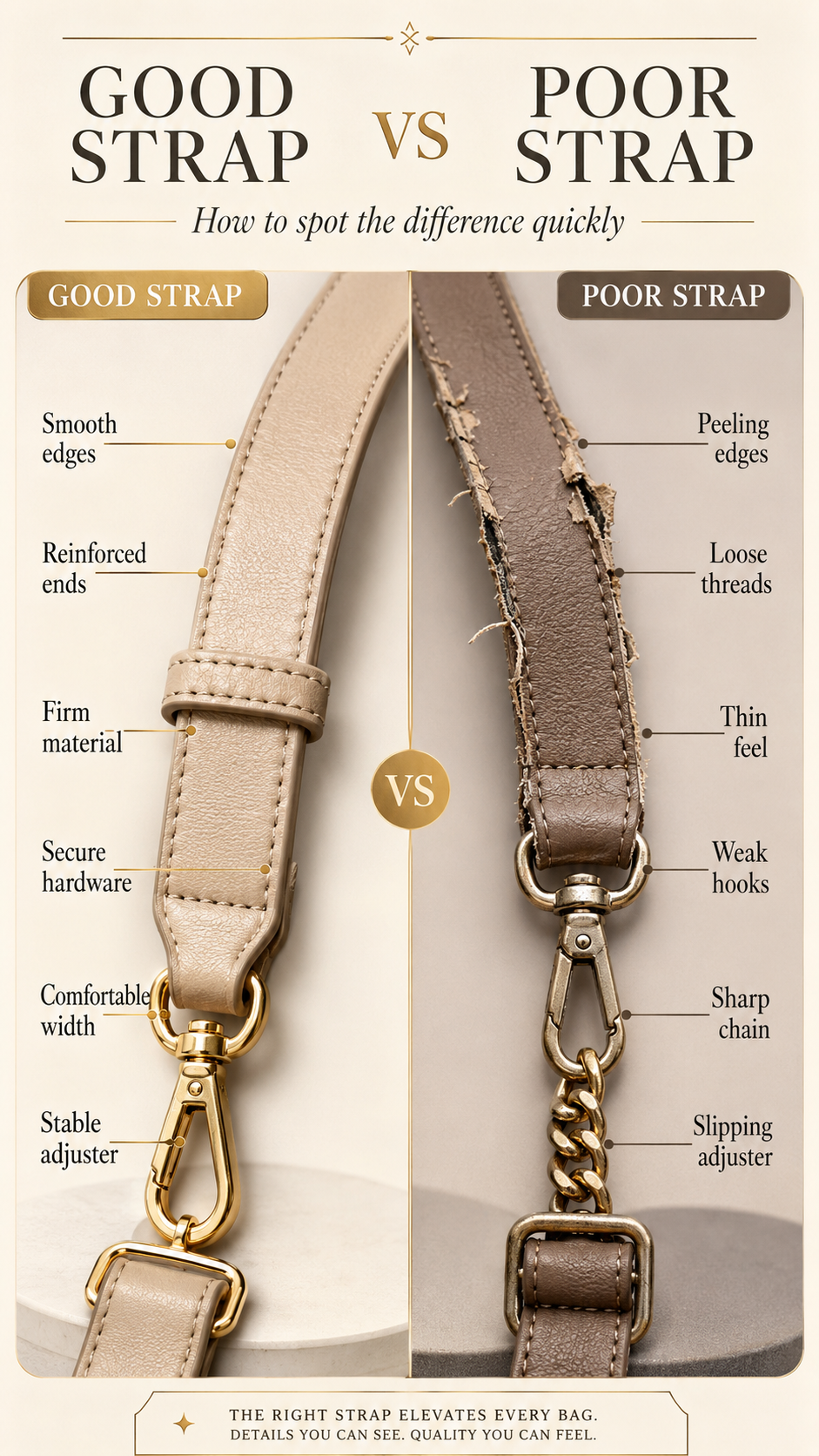
Good Strap vs Poor Strap
A good strap should feel like part of the bag’s structure. A poor strap often feels like a decorative add-on. The difference becomes clear when you compare edges, stitching, anchor strength, adjuster stability, and comfort.
Good Strap
Smooth Edges
Sealed, dry, clean, and comfortable against skin or clothing.
Reinforced Ends
Extra stitching, secure folds, or rivet support where tension is highest.
Firm Material
Flexible enough to wear, strong enough to support the bag.
Secure Hardware
Hooks, rings, and clasps feel stable and aligned.
Comfortable Width
Strap width feels proportional to the size and purpose of the bag.
Stable Adjuster
Buckle or slider keeps the chosen length during normal wear.
Poor Strap
Peeling Edges
Cracked, sticky, or rough finish that may worsen with use.
Loose Threads
Weak thread near strap ends or hardware folds.
Thin Feel
Looks wide but feels hollow, floppy, or unsupported.
Weak Hooks
Thin clasp, poor spring action, rough movement, or misalignment.
Sharp Chain
Open links, rough seams, or edges that may snag clothing.
Slipping Adjuster
Slider drifts and makes the bag hang lower while walking.
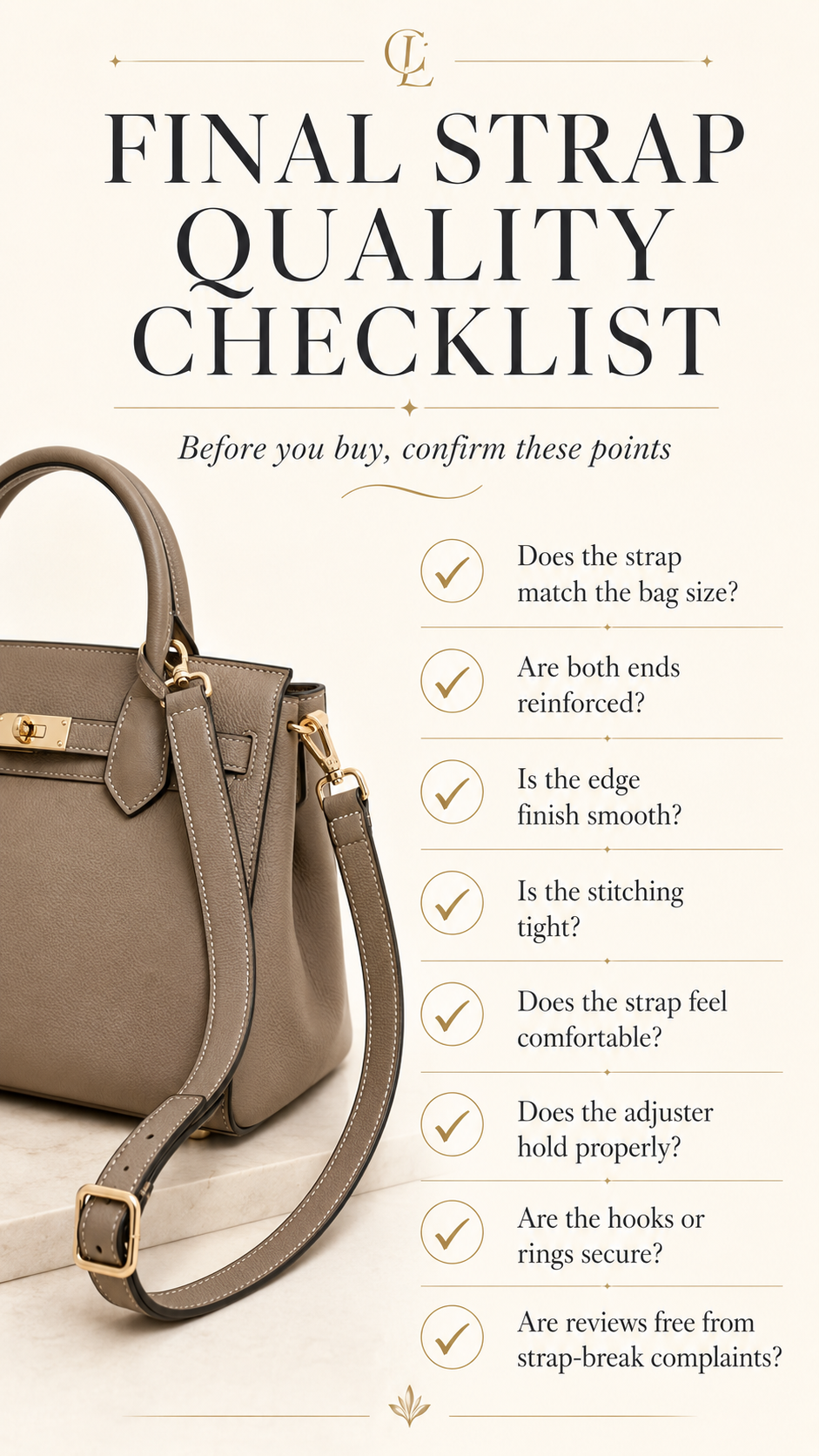
Final Buyer Checklist for Handbag Strap Quality
Before checkout, use this final checklist. It works for in-store shopping and online order inspection after delivery.
Bag Size Match
Does the strap feel strong enough for the size and purpose of the bag?
Reinforced Ends
Are both strap ends secured with strong stitching, folds, tabs, or hardware?
Smooth Edges
Is the edge finish smooth, sealed, dry, and free from peeling?
Tight Stitching
Are stitch lines straight, controlled, and clean near high-stress zones?
Comfort Feel
Does the strap sit naturally without cutting, twisting, or sliding constantly?
Adjuster Hold
Does the buckle, slider, or snap system keep the selected length?
Secure Hooks and Rings
Do the hardware parts feel stable, smooth, and properly aligned?
Review Pattern
Are reviews free from repeated strap complaints such as peeling, breaking, slipping, or discomfort?
| Buyer Decision | What It Means | Recommended Action |
|---|---|---|
| Passes most checks | Strap appears suitable for normal use | Proceed if size, style, and price also fit your needs |
| One minor issue | May still be acceptable depending on bag purpose | Check return policy and avoid overloading |
| Several red flags | Strap may affect comfort or durability | Compare another model before buying |
| Weak attachment point | Core carry security is uncertain | Avoid for daily use unless professionally inspected |
Source and Verification Note
This guide is written as a practical buyer inspection article, not a laboratory testing report. It avoids fixed universal claims about exact strap break limits because those values may vary by material, stitching method, hardware type, factory testing, climate, and daily carry habits.
For a specific handbag, always check the exact product page, material label, strap length, strap drop, adjustability, return terms, and seller-provided care instructions. You can also compare your bag with the LA GLOSSÉ bag selection philosophy for a more careful buying approach.
Pros & Cons
What We Loved
- Helps buyers inspect handbag strap quality before purchase
- Covers material, edge finish, stitching, anchor points, adjusters, and comfort
- Uses visual buyer boards instead of plain text explanations
- Includes online shopping checks for product photos, reviews, and return terms
- Explains strap needs by tote, satchel, crossbody, bucket, evening, and hobo styles
- Connects strap quality with related bag hardware, stitching, zipper, and lining checks
Worth Knowing
- Exact strap break limits are usually not publicly available
- Comfort can vary by body height, shoulder shape, clothing, and daily carry weight
- Online photos may hide strap attachment details
- Material claims must be checked on the exact listing
- A visual inspection cannot replace professional repair assessment or lab testing
Frequently Asked Questions
How can I tell if a handbag strap is good quality?
A good handbag strap should feel firm, flexible, smooth at the edges, secure at the ends, and comfortable when worn. Check material feel, stitching, attachment hardware, adjuster stability, and shoulder comfort before buying.
What is the most important part of a handbag strap to check?
The strap ends and attachment points are the most important areas. These zones carry repeated pulling stress, so check the tabs, hooks, rings, rivets, folds, and stitching carefully.
What are the biggest red flags in handbag strap quality?
Major red flags include peeling edges, loose thread near the ends, weak hooks, stretched buckle holes, chain links with gaps, sharp edges, slippery straps, and attachment tabs pulling away from the bag body.
Is leather always better than faux leather for handbag straps?
Not always. A well-finished faux leather strap can work for light or occasional use, while a poorly finished leather strap can still be uncomfortable. Check the exact material, edge finish, stitching, and attachment quality before deciding.
Why do handbag straps peel?
Peeling often happens when a coated surface, edge paint, or synthetic layer begins separating from the base material. Friction, moisture, heat, and lower-quality finishing can make peeling appear faster.
Are chain straps durable?
Chain straps can be durable when the links are smooth, closed, and securely attached. Avoid chains with open gaps, sharp seams, rough plating, or weak connecting rings.
How wide should a handbag strap be?
The strap should be proportional to the bag size and expected carry weight. Mini and evening bags can use slimmer straps, while larger totes, satchels, and travel bags usually need more supportive straps.
How do I test an adjustable handbag strap?
Set the strap to your preferred length, then gently pull below the buckle or slider. A good adjuster should hold the selected length without slipping, tearing, or digging into your shoulder.
How do I check strap comfort before buying?
Wear the bag briefly with realistic items inside if possible. The strap should not cut into your shoulder, twist at your neck, slide off repeatedly, or make the bag bounce awkwardly.
Can a thin strap hold a heavy bag?
A thin strap may not be ideal for a heavy bag because it can feel uncomfortable and may place too much stress on small attachment areas. Thin straps are usually better for mini or evening bags with light contents.
What should I check when buying a handbag online?
Zoom into strap photos, inspect customer images, search reviews for strap complaints, confirm strap length and material, check if the strap is adjustable or detachable, and review return terms before ordering.
Are detachable straps safe for daily use?
Detachable straps can be safe when the hooks, rings, and tabs are strong and well aligned. The clasp should close securely and the strap should hang naturally without twisting.
How do I know if the strap attachment is strong?
Hold the bag body with one hand and gently pull the strap with the other. The attachment should stay flat and stable without tab lifting, panel puckering, hardware bending, or thread cracking.
Do tote bags need stronger straps than small crossbody bags?
Usually yes. Tote bags are often used for more items, so handle bases, tabs, and shoulder straps should feel more reinforced. Small crossbody bags focus more on adjustability, comfort, and strap placement.
Should I avoid a bag if the strap details are missing online?
Not always, but be careful. If strap length, material, adjustability, or close-up photos are missing, check customer images and return terms before ordering.
A Good Strap Makes the Bag Feel Reliable
Handbag strap quality is one of the strongest signs of real-world usability. The strap decides how the bag feels on your shoulder, how stable it feels when lifted, and how confidently it handles normal daily movement.
Before buying, check the material, edge finish, stitching, attachment points, adjuster, comfort, and online review patterns. A strap does not need to be overly thick or heavy to be good, but it must match the bag’s size and purpose.
Continue with the handbag zipper quality guide, the handbag hardware quality guide, or browse more curated everyday styles in the LA GLOSSÉ shop.